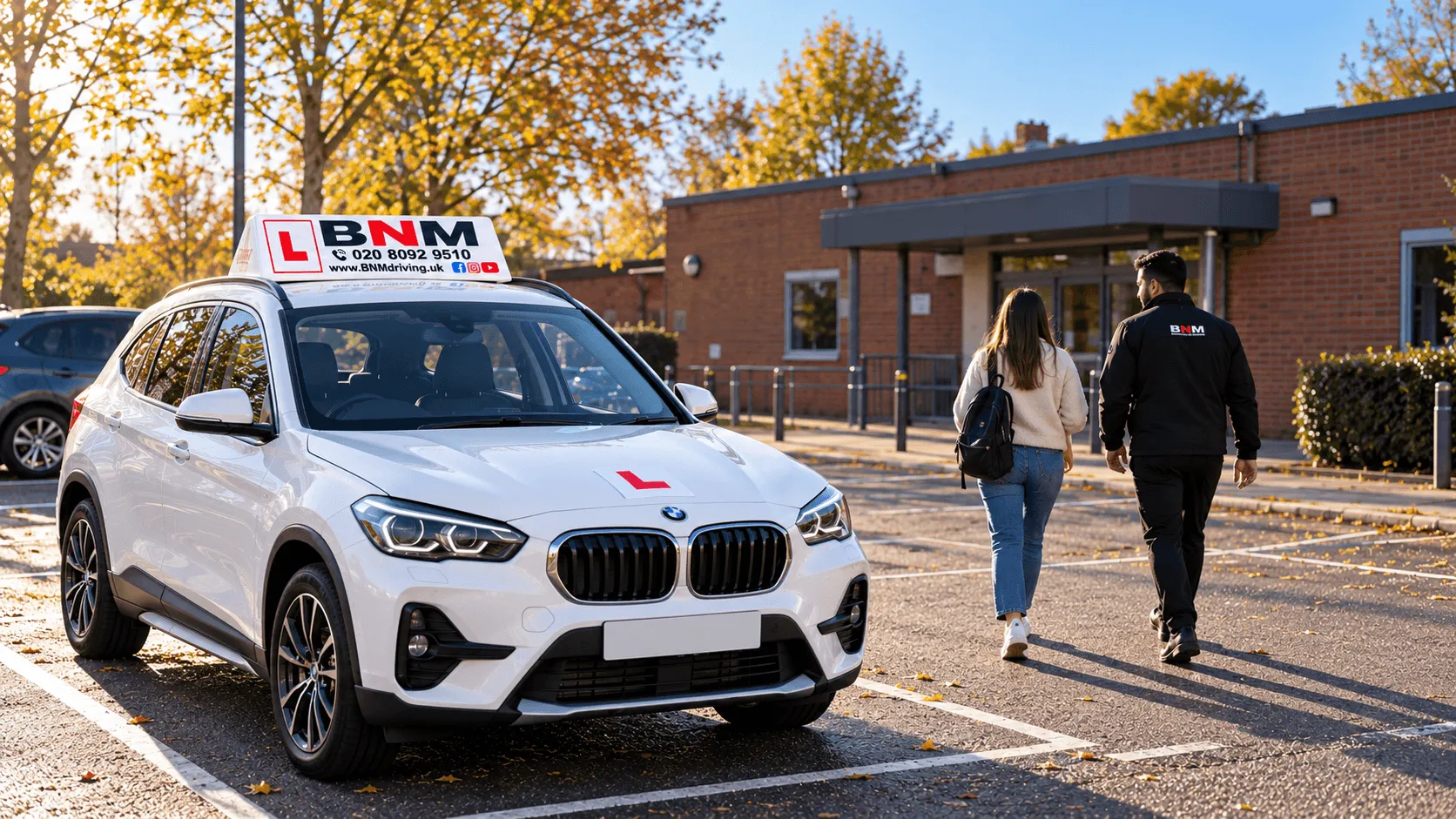
The UK driving test lasts around 35 minutes of driving and has 4 parts: an eyesight check, 2 vehicle safety questions, general driving ability with 20 to 35 minutes of independent driving, and one reversing manoeuvre. Below are the parts, the length and what happens before you drive. Then come the drive itself, the manoeuvre, independent driving and the marking. Last are your result, practising your own test routes and the questions learners ask most.
What are the 4 parts of the UK driving test?
The UK driving test has 4 parts (GOV.UK): an eyesight check, the 2 “show me, tell me” safety questions, general driving ability and reversing your vehicle. The test is the same in a manual and an automatic car. The table below sets out what happens in each part and when it comes:
| Part | What happens | When |
|---|---|---|
| Eyesight check | Read a number plate from 20 metres, or 20.5 metres for an old-style plate | At the test centre, before you drive |
| Safety questions | Answer one “tell me” question, then do one “show me” task at the wheel | One before the drive, one during it |
| General driving | Drive in varied traffic, pull over and pull away, and drive independently for 20 to 35 minutes | Most of the 35 minutes |
| Reversing | Do one reversing exercise, chosen by the examiner from 4 possible versions | Once during the drive |
Source: the GOV.UK driving test guide for cars (checked 12 November 2026).
Independent driving and the emergency stop sit inside general driving ability, which is why some guides count 5 or 6 parts. DVSA counts 4. Nothing in the test is a surprise: the national standard for driving cars lists every skill the examiner can mark.
How long does the driving test last?
The driving test lasts around 35 minutes of driving, and an extended test after a driving ban lasts around 65 minutes (GOV.UK). Many guides still say 40 minutes, which was the older figure. Your appointment runs longer than the drive, because the licence check, the eyesight check and the result all happen at the test centre.
The test costs £62 on a weekday. An evening, weekend or bank holiday test costs £75 (GOV.UK, checked 12 November 2026). An extended test costs £124 and £150. Book a lesson before the test, so you arrive warmed up rather than cold.
What happens before you drive?
Before you drive, the examiner checks your documents, runs the eyesight check and asks one safety question. These 5 steps happen in order at the test centre (GOV.UK):
- Check inThe examiner calls your name, checks your UK photocard licence and confirms your theory test pass on their system.
- DeclareTell the examiner about a disability, health condition or any adaptation fitted to the car, and ask for the adjustments you need.
- ReadRead a number plate from 20 metres, or 20.5 metres for an old-style plate. Failing the eyesight check ends the test.
- AnswerAnswer the “tell me” question at the car, before the engine starts. There are 14 “tell me” questions and 7 “show me” tasks in the official list.
- DecideSay whether you want your instructor or a relative in the back seat and with you for the result. They must be over 16 and take no part in the test.
You must be recognisable from your licence photo, and a paper licence needs a valid passport with it. Your test is cancelled and the fee is lost if you turn up without the right documents or in a car that breaks the rules. One wrong answer, or two, to the safety questions costs one driving fault, not a fail.
What happens while you drive?
While you drive, the examiner marks your general driving ability in everyday traffic, and never on a motorway. The route mixes junctions, roundabouts, main roads and quiet streets. You stop and pull away in 3 set situations (GOV.UK):
- A normal stop: pull up safely at the side of the road, then move off again.
- A move off at an angle: pull out from behind a parked vehicle.
- A hill start: move off uphill without rolling back.
The “show me” task comes while you drive. You operate a control with the car moving, such as the rear demister or the windscreen washer. The examiner can also ask for an emergency stop, which does not happen on every test, and pulls you over first to explain the signal. Mistakes do not end the test: the examiner stops a test only when your driving puts other road users in danger.
Which reversing manoeuvre will you get?
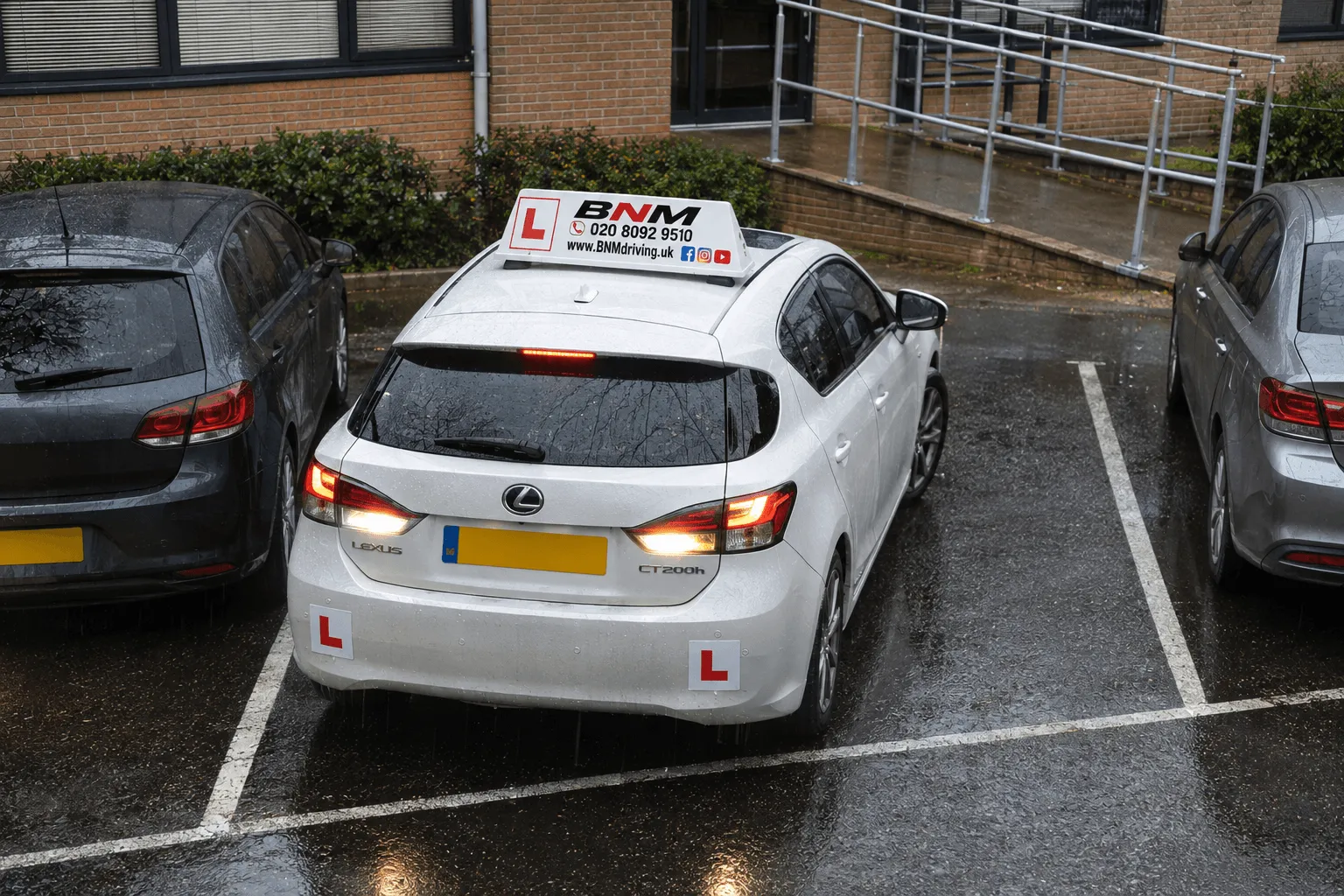
The reversing manoeuvre is one exercise chosen by the examiner, and 4 versions are possible on a car test. The list below names each one (GOV.UK):
- Parallel park: reverse into a gap at the side of the road, behind a parked car.
- Forward bay park: drive forward into a parking bay, then reverse out.
- Reverse bay park: reverse into a parking bay, then drive out.
- Pull up on the right: stop on the right-hand side, reverse about 2 car lengths, then rejoin the traffic.
You learn which exercise you have on the day, so practise all 4. Bay parks happen in the test centre car park or a public car park, and the other 2 happen on quiet residential roads. Reversing around a corner and the turn in the road left the test in December 2017 (DVSA). Both stay on the lesson plan as road skills, not as marked exercises.
How does independent driving work?
Independent driving lasts 20 to 35 minutes, and you follow a sat nav, traffic signs or both (GOV.UK). The examiner chooses which, sets the sat nav up and gives you turn-by-turn directions at any point when you are following neither. You cannot use your own sat nav. These 4 rules protect you during the section:
- A wrong turn is not a fault: the examiner helps you back onto the route.
- A hidden sign is not your problem: the examiner gives directions until the next visible sign.
- Directions keep coming: you are never left guessing where to go next.
- Adjustments exist: learners with learning difficulties can ask to follow traffic signs instead of a sat nav.
Independent driving is where South London routes get busy. Bus lanes, red routes, yellow box junctions and 20 mph limits arrive while you read the signs. Read the road first and the sat nav second: the examiner marks your driving, not your navigation.
How is the driving test marked?
The driving test is marked in 24 areas, and the examiner records 3 types of fault in each one (DVSA). Junctions, use of mirrors, use of speed, moving off, positioning and the safety questions are 6 of those areas. The table below defines each fault type and what it does to your result:
| Fault type | What it means | Effect |
|---|---|---|
| Driving fault | A mistake that is not potentially dangerous, often called a minor | Up to 15 allowed |
| Serious fault | Something potentially dangerous, often called a major | One is a fail |
| Dangerous fault | Actual danger to you, the examiner, the public or property | One is a fail |
Source: DVSA guidance on understanding your driving test result (checked 12 November 2026).
You pass with no more than 15 driving faults and no serious or dangerous fault. The same driving fault repeated turns into a serious fault, so one weak habit matters more than 15 different slips. Your result also shows “examiner took action” when the examiner had to speak or take the controls to avoid an incident. The DVSA guide to understanding your test result lists the common faults in all 24 areas.
What happens at the end of the driving test?
At the end of the driving test, the examiner gives your result at the test centre and names every fault you made. A pass comes with a pass certificate, and DVSA emails you the list of driving, serious and dangerous faults. You can start driving straight away, as long as your insurance covers you without a supervising driver.
Hand your provisional licence to the examiner, and DVLA sends your full licence automatically. Without that, apply for the full licence within 2 years of passing. Contact DVLA when the licence has not arrived 3 weeks after you applied.
A fail means booking again, with a retest date at least 10 working days away. At BNM, a failed test costs at least £277: the retest fee, test car hire and the lesson before it. Another 2 hours of practice is the cheaper option. Appeals go to a court within 6 months in England and Wales, or 21 days in Scotland. A successful appeal wins a refund or a free retest, never a changed result.
Practising your test routes in South and South West London
Practising the roads around your own test centre is the closest thing to the real test. Test routes stopped being published on 4 October 2010. BNM covers 3 test centres: Mitcham, Morden and Tolworth. The table below compares their 2025-26 pass rates with the national figure, plus the median wait for a test:
| Test centre | Pass rate | Median wait |
|---|---|---|
| Mitcham | 47.0% | 16.1 weeks |
| Morden | 51.0% | 19.1 weeks |
| Tolworth | 53.6% | 23.1 weeks |
| Great Britain | 50.0% | – |
Sources: DVSA DRT122A for 2025-26 pass rates and DRT122F for median waits in September 2026. Waits change every month.
Public route guides for Morden name St Helier Avenue, Rose Hill roundabout and Central Road. Mitcham routes reach the tram crossing on Beddington Lane and the Lombard roundabout on Purley Way. Our guide to the driving test centres in South London covers each one in detail. The video below is a full test route filmed at Mitcham.

In our experience, learners settle fastest when the last 2 lessons copy the test. Same time of day, same roads, and no coaching from the passenger seat. A mock test costs £45 and runs the full 35 minutes with marking. Our guide to passing your driving test first time sets out the rest of the preparation. Book your test only when you can do everything without instruction, which is the standard GOV.UK itself sets.
Your theory test pass has to be in place before the practical test is bookable, and the certificate lasts 2 years. Our driving theory test guide covers the 50 questions and hazard perception.
Frequently asked questions
How long does the UK driving test take?
You drive for around 35 minutes on a standard car test (GOV.UK). An extended test after a driving ban lasts around 65 minutes. The appointment itself is longer, because checks and the result happen at the test centre.
How many faults can you get and still pass?
You pass with up to 15 driving faults and no serious or dangerous fault. The same driving fault repeated becomes a serious fault, which is a fail.
Do you have to do an emergency stop?
Not on every test. GOV.UK says the examiner can ask you to carry out an emergency stop, so practise it before test day. The examiner pulls you over first and explains the signal.
Can you use your own sat nav on the driving test?
No. The examiner brings a sat nav and sets it up for you, and your own sat nav is not allowed. The examiner decides whether you follow the sat nav, traffic signs or both.
Does a wrong turn fail your driving test?
No. The examiner does not record a fault for a wrong turning and helps you get back on the route. Only the standard of your driving counts.
How long is the independent driving part?
Independent driving lasts 20 to 35 minutes of the drive (GOV.UK). You follow a sat nav, traffic signs or a combination of the two, as the examiner tells you.
When do you get your driving test result?
You get the result at the test centre, straight after the drive. The examiner names your faults, and DVSA emails the full list of driving, serious and dangerous faults.
How soon can you retake a failed driving test?
You choose a retest date at least 10 working days away, and you pay the fee again. Book it once your instructor agrees that you are ready.
From the UK driving test to an intensive driving course in South London
BNM Driving School is a local, independent driving school based in Hackbridge (SM6). Our DVSA-approved instructors teach manual and automatic lessons across South and South West London, and prepare learners for tests at Mitcham, Morden and Tolworth. Our learners have a 98% pass rate, and more than 2,000 have passed with us.
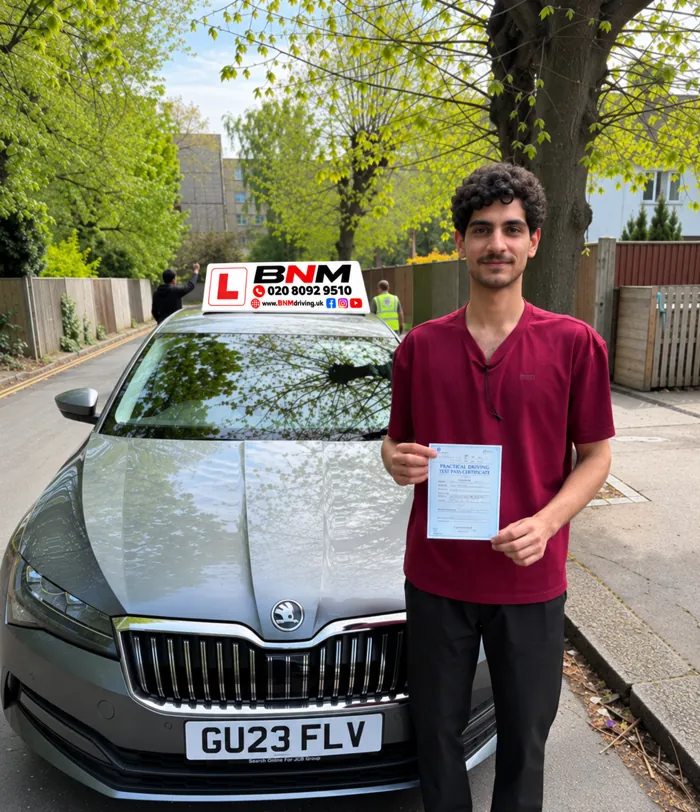
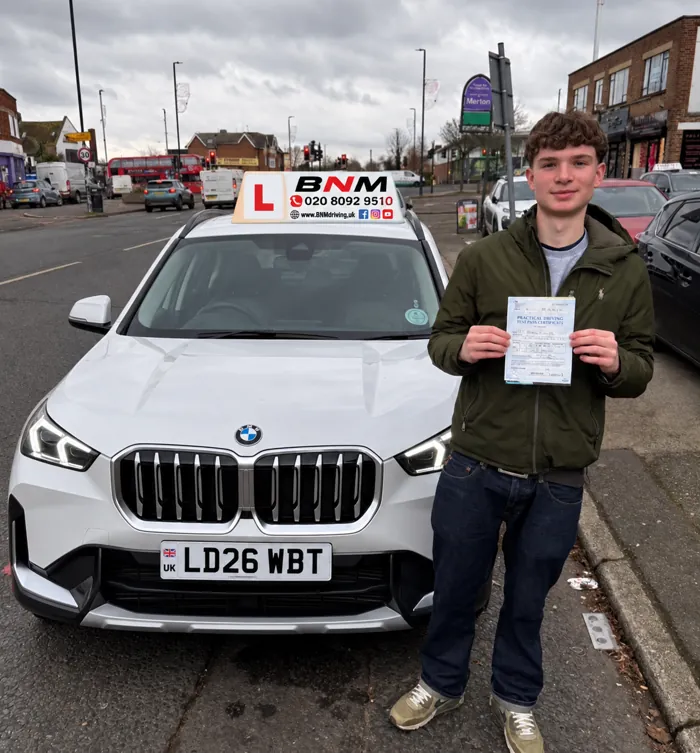
Every part of the driving test is practised on local roads before test day, from the eyesight check to independent driving and the 15-fault pass mark. Learners with a deadline take our 30-hour intensive course, which includes a mock test on the routes around your centre.