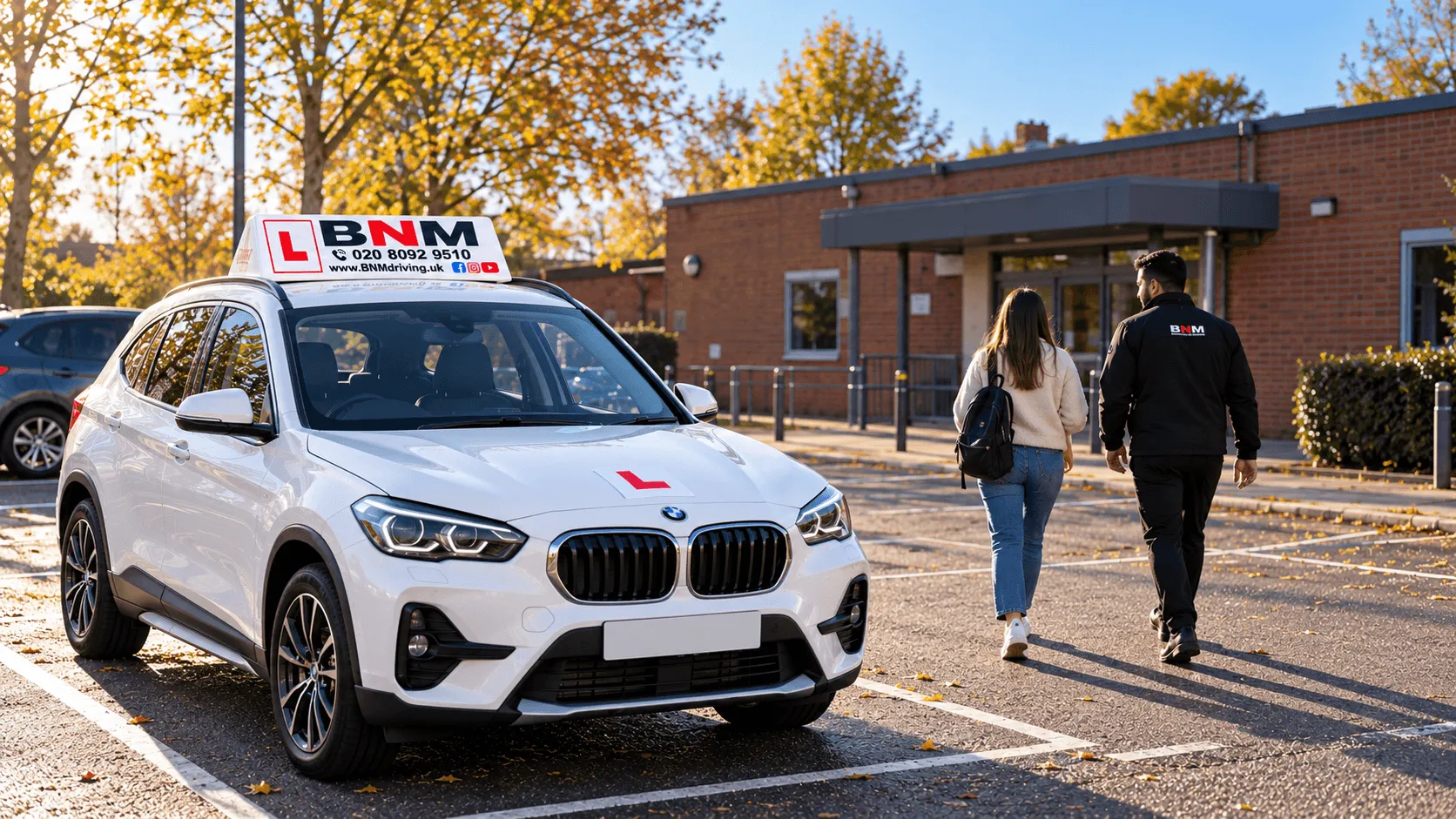
To pass your driving test first time, follow 8 steps: start lessons early, drive every week, learn your test centre’s roads, fix the top fail reasons and pass a mock test before test day. Below are the steps, your real chances at each South London test centre and how to practise on local test routes. Then come the top 10 fail reasons, a readiness check, tips by type of learner, common mistakes, the 2026 booking rules, test day and the cost of a fail.
How to pass your driving test first time
To pass your driving test first time, follow these 8 steps in order. Each one is explained further down the page:
- Start lessons before your theory testDriving while you revise makes the Highway Code real. DVSA found that learners with no lessons before their theory test were 25% more likely to fail their driving test first time.
- Drive every weekA 2-hour lesson every week keeps skills fresh. Long gaps mean the first part of each lesson goes on relearning.
- Add private practiceExtra hours with a family member build confidence in real traffic, as long as the supervisor and insurance meet the rules.
- Learn the roads around your test centreDVSA doesn’t publish test routes, so practise every type of junction, roundabout and speed limit near your centre.
- Practise all 3 reversing manoeuvresThe examiner picks one: a parallel park, a bay park or pulling up on the right and reversing about 2 car lengths.
- Fix the top 3 fail reasonsObservations at junctions, mirror checks before changing direction and moving off safely cause more fails than anything else.
- Pass a mock test firstA mock test in test conditions shows the faults you still make without your instructor’s prompts.
- Book a test date you’ll be ready forSince 31 March 2026, you can change a booking only twice, so pick a date your instructor agrees with.
What are your chances of passing first time?
Your chances of passing first time are about 1 in 2. In Great Britain, 50.5% of first attempts at the car test passed in 2025–26, according to DVSA. DVSA’s Ready to Pass campaign says 48 out of every 100 tests were failed in September 2026.
First-time pass rates at the 3 South London test centres range from 46.3% to 53.7%. The table below compares first attempts, all tests and automatic tests at each centre:
| Test centre | First attempt | All tests | Automatic |
|---|---|---|---|
| Mitcham | 46.3% | 47.0% | 45.4% |
| Morden | 50.4% | 51.0% | 49.8% |
| Tolworth | 53.7% | 53.6% | 49.9% |
| Great Britain | 50.5% | 50.0% | 44.6% |
Car tests, April 2025 to March 2026: DVSA DRT122A, DRT122C and DRT122E (June 2026). The Great Britain automatic figure is from an AA Driving School analysis of DVSA data (August 2026).
A centre’s pass rate reflects the learners who test there as well as its roads. A gap of 7 points between Mitcham and Tolworth matters less than how well you know the roads. Take your test at the centre where you’ve had most of your lessons.
How to pass first time on South London test routes
To pass first time on South London test routes, practise the roads around your test centre until every junction type feels routine. GOV.UK says test routes aren’t published, so you can’t learn one route by heart. You can learn the types of road the examiner is likely to use.
In our experience, South London test routes take in 5 London features that learners outside London rarely meet in one drive. They are listed below:
- Bus lanes: each one has its own hours on a blue sign, and you can’t drive in one during those hours.
- Red routes: you can’t stop on double red lines at any time, so plan where to pull over when the examiner asks.
- 20 mph zones: many residential roads in South London have a 20 mph limit, and the limit changes often from road to road.
- Box junctions: you can enter the yellow box only when your exit is clear, unless you’re turning right and only oncoming traffic stops you.
- Parked cars on narrow roads: you’ll meet oncoming traffic with one gap, so you need to judge who goes first.
Independent driving lasts 20–35 minutes of the test. You’ll follow a sat nav set up by the examiner, traffic signs, or both. Taking a wrong turn isn’t a fault, and the examiner helps you back onto the route (GOV.UK).
Watching a real test route shows how these features come together. The video below shows a full Morden test route, filmed by BNM in September 2025:

Learners at Mitcham, Morden and Tolworth meet the same test, but different roads. Practise in the area of the centre you’ve booked, not only near home. Our comparison of South London driving test centres gives each centre’s pass rate, wait and route video.
The 10 most common reasons learners fail
The 10 most common reasons learners fail start with poor observations at junctions, followed by mirror checks and moving off. The table below lists DVSA’s top 10 for April 2024 to March 2025, with one fix for each:
| Reason for failing | How to avoid it |
|---|---|
| 1. Observations at junctions | Look properly and judge the speed of approaching traffic before you pull out. |
| 2. Mirrors when changing direction | Check your mirrors before you signal, change direction or change speed. |
| 3. Moving off safely | Check your mirrors and blind spot, then pull away only into a safe gap. |
| 4. Turning right at junctions | Position close to the centre of the road without blocking oncoming traffic. |
| 5. Traffic lights | Go on green only when the junction is clear, and never stop inside it. |
| 6. Steering control | Steer smoothly and on time, so you don’t clip kerbs or swing wide. |
| 7. Road markings | Follow arrows, lane lines and box junctions as they tell you. |
| 8. Traffic signs | Obey lane signs and every change of speed limit. |
| 9. Position on the road | Stay in the middle of your lane and change lanes only when you need to. |
| 10. Speed | Match your speed to the limit, the traffic and the weather, so you can stop in the distance you can see. |
Source: DVSA, top 10 reasons for failing the car driving test in Great Britain, April 2024 to March 2025 (updated 14 August 2025).
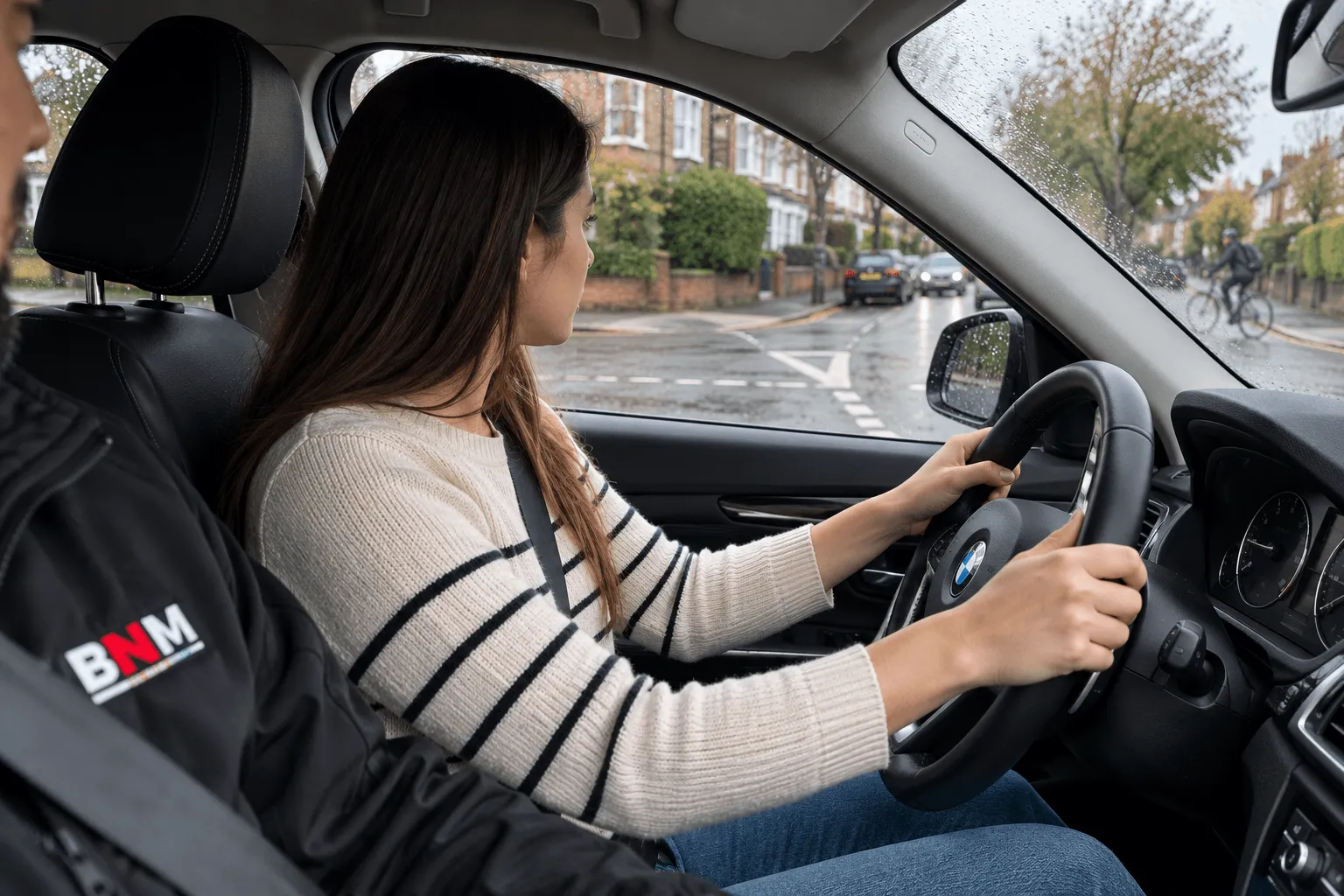
Each reason comes with a fuller explanation in the GOV.UK guide to the top 10 reasons for failing the driving test.
How do driving faults, serious faults and dangerous faults differ?
Driving faults, serious faults and dangerous faults differ in how much risk they cause. GOV.UK defines 3 types:
- Driving fault: not potentially dangerous, but the same fault repeated can become a serious fault.
- Serious fault: something potentially dangerous, such as pulling out in front of a car that has to brake.
- Dangerous fault: actual danger to you, the examiner, the public or property.
You pass with no more than 15 driving faults and no serious or dangerous faults. One serious fault means a fail, so a calm, safe drive with a few minors beats a quick drive with one bad junction.
How to know you’re ready for your driving test
You’re ready for your driving test when you meet DVSA’s 5 signs of readiness. The Ready to Pass campaign lists them as follows:
- No prompts: you drive without your instructor telling you what to do.
- No serious mistakes: you don’t make serious or dangerous faults on lessons.
- Mock tests passed: you can pass mock driving tests.
- Nerves managed: you’ve practised ways to manage your nerves.
- Instructor agrees: your instructor agrees you’re ready.
Use the check below to see where you stand today. Tick each statement that’s true for you:
Check if you’re ready for your test
The first 5 statements are DVSA’s signs of readiness. The last 3 are the local checks our instructors use.
Not ready yet. Work through the unticked items with your instructor. If your test is close, you can move it free with at least 10 full working days’ notice.
A mock test is the clearest single check. In a DVSA survey, 94% of learners who had taken a mock test said they’d recommend one. A good mock test includes the eyesight check, the safety questions, independent driving and the emergency stop.
Hours matter less than the 5 signs. GOV.UK sets no minimum number of lessons. Driving Standards Agency research found that learners took about 45 hours of lessons plus 22 hours of private practice. Our guide to how many lessons you need to pass shows how that figure varies by learner.
How to pass first time as a nervous, automatic or intensive learner
How to pass first time changes a little for each type of learner. The 4 learner types below cover nervous learners, automatic learners, intensive course learners and learners practising with family.
Nervous learners
Nervous learners pass first time more often when the test holds no surprises. DVSA’s Ready to Pass campaign says 1 in 10 people who fail the driving test say it was mostly down to nerves. Watch real test routes, take a mock test with the same start and finish as the real one, and know that you can carry on after a mistake. Our guide to driving lessons for nervous learners covers test nerves in more detail.
Automatic learners
Automatic learners take the same test, with the same 15-fault limit. An automatic removes the clutch and gear changes, but not the observations, mirrors and positioning that top the fail list. Automatic tests had a 44.6% pass rate in Great Britain in 2025–26 (AA analysis of DVSA data). Use the same 5 signs of readiness before you book, whatever the gearbox.
Intensive course learners
Intensive course learners fit a whole course, often 30 hours, into 1–2 weeks just before a test date. Pass your theory test and book the practical test first, because South London waits run to 16–23 weeks. An intensive course suits learners with some experience best. Complete beginners often need more than 30 hours, so a mock test halfway through shows whether the test date is realistic.
Learners practising with family
Learners practising with family add extra hours between lessons at little cost. The supervisor must be 21 or over, qualified to drive that type of car and have held a full licence for 3 years (GOV.UK). You need insurance that covers you as a learner, plus L plates. Ask your instructor which skill to practise that week, so private practice repeats the same routine, not old habits.
Common mistakes that cost a first-time pass
There are 6 common mistakes that cost learners a first-time pass. Each one is avoidable:
- Booking the test to beat the wait: a date 16–23 weeks away feels safe, but with only 2 changes allowed, a rushed date is hard to move twice.
- Learning one route by heart: routes aren’t published, so learn the types of junction near your centre instead.
- Skipping the mock test: without one, the first time you drive in test conditions is the test itself.
- Testing in an unfamiliar car: a different car changes the biting point, the brakes and the mirrors on the day.
- Giving up after one mistake: a minor fault doesn’t fail you, so keep driving to your normal standard.
- Letting someone else book the test: since 12 May 2026, only the learner can legally book or change a driving test.
A planned course of lessons stops most of these mistakes. If your lessons feel unplanned, read how to choose a driving instructor who tracks your progress against the test.
Driving test booking rules in 2026
Driving test booking rules changed 3 times in 2026, and each change affects a first-time plan. These are the 4 booking rules learners need to know, from GOV.UK:
- 2 changes only: since 31 March 2026, you can change your booking 2 times. Changing the date and centre together counts as 1 change.
- Learner books: since 12 May 2026, it’s against the law for anyone other than the learner to book or change a car test. Booking-scanning apps aren’t allowed either.
- 3 nearest centres: since 9 June 2026, you can move your test only to one of the 3 nearest test centres to the original booking.
- Free changes: changing your test is free with at least 10 full working days’ notice (Monday to Saturday).
The full rules are on GOV.UK’s page about changes to driving test booking rules in 2026. Our guide to the driving test booking rules explains swaps, refunds and where a Mitcham, Morden or Tolworth test can move.
Waiting times decide how far ahead you book. The table below shows the median wait from booking to test at each local centre:
| Test centre | Median wait (weeks) |
|---|---|
| Mitcham | 16.1 |
| Morden | 19.1 |
| Tolworth | 23.1 |
Median wait from booking to test, September 2026: DVSA DRT122F (October 2026). Waits change every month.
What happens on test day
On test day, the practical driving test runs in 6 stages, with around 35 minutes of driving. GOV.UK sets them out in this order:
- Documents: bring your UK driving licence. Without it, the test is cancelled and you don’t get your money back.
- Eyesight check: read a number plate from 20 metres (20.5 metres for an old-style plate). Fail it and the test ends.
- “Tell me” question: answer 1 vehicle safety question before you drive.
- General driving: drive in different road and traffic conditions, with a normal stop, a hill start and pulling out from behind a parked car. Some tests include an emergency stop.
- “Show me” question and independent driving: answer 1 safety question while driving, then follow a sat nav or signs for 20–35 minutes.
- Reversing manoeuvre: do 1 of the 3 manoeuvres the examiner chooses.
Your instructor, a relative or a friend over 16 can sit in the back, but can’t take part. At the end, the examiner tells you the result and goes through your faults.
What a failed test costs
A failed test costs at least £277 in South London. That covers a new £62 weekday test, £140 test car hire and a warm-up lesson at £75 for a 2-hour lesson. Your next test must be at least 10 working days away (GOV.UK), and local waits are 16–23 weeks.
A £45 mock test costs less than a sixth of a fail. Our guide to what a failed driving test costs shows the full sum.
How we prepare learners to pass first time
We prepare learners to pass first time on the roads around the Mitcham, Morden and Tolworth test centres. Our 4 DVSA-approved instructors are Syed Nauman Ali, Martin West, Marine Averlan and Paul Wylde, and a female instructor is available on request. We teach manual and automatic lessons in dual-control cars. Lessons cost £75 for a 2-hour lesson, or £36.50 an hour when you book a 10-hour block. The 20-hour block costs £730 and includes a mock test, and the 30-hour intensive course costs £1,125, also with a mock test. You can book a mock test on its own for £45.
Frequently asked questions
What percentage of people pass first time?
About half. In Great Britain, 50.5% of first attempts passed in 2025–26 (DVSA). First attempts passed at 46.3% in Mitcham, 50.4% in Morden and 53.7% in Tolworth.
What is the most common reason for failing?
Not making effective observations at junctions. It topped DVSA’s list of fail reasons for April 2024 to March 2025, ahead of mirror checks when changing direction.
How many minors can you get and still pass?
Up to 15. You pass with 15 or fewer driving faults and no serious or dangerous faults (GOV.UK).
Is a wrong turn a fault on the driving test?
No. A wrong turn during independent driving isn’t a fault, and the examiner helps you back onto the route (GOV.UK).
Can you fail before you start driving?
Yes. The test ends if you can’t read a number plate from 20 metres. It’s cancelled with no refund if you don’t bring your licence (GOV.UK).
Is it easier to pass first time in an automatic?
No. Automatic tests had a 44.6% pass rate in 2025–26, against about 52% for manual (AA analysis of DVSA data; the manual figure is our estimate).
Which South London test centre is easiest to pass first time?
Tolworth had the highest first-attempt pass rate of the 3 local centres, at 53.7% in 2025–26 (DVSA). It also had the longest median wait, at 23.1 weeks in September 2026.
How soon can you retake a failed test?
After at least 10 working days (GOV.UK). With South London waits of 16–23 weeks, the next free date is usually several months away.
Passing your driving test first time on a fast-track driving course
BNM Driving School is a local, independent driving school based in Hackbridge (SM6). Our DVSA-approved instructors teach manual and automatic lessons across South and South West London, on the roads around the Mitcham, Morden and Tolworth test centres. Our learners have a 98% pass rate, and more than 2,000 have passed with us.
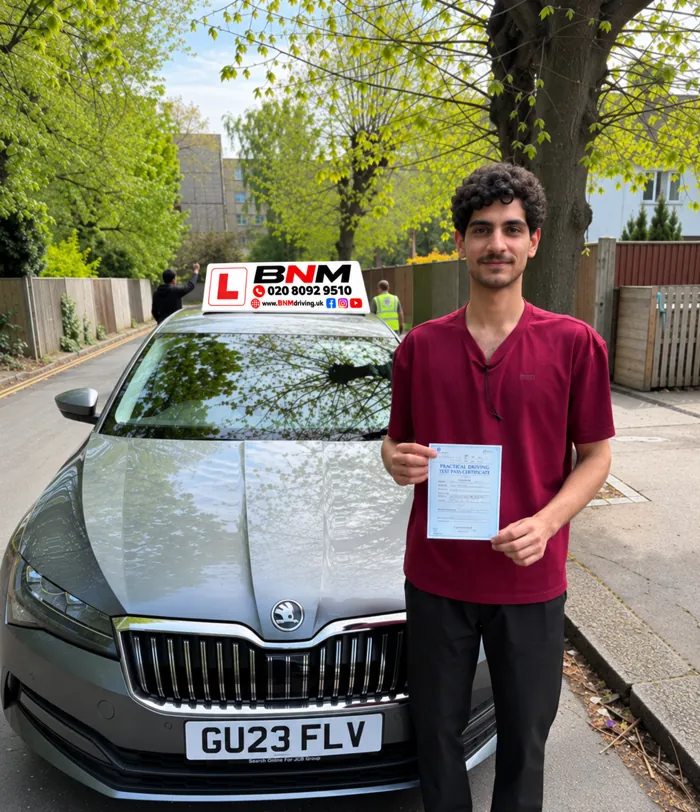
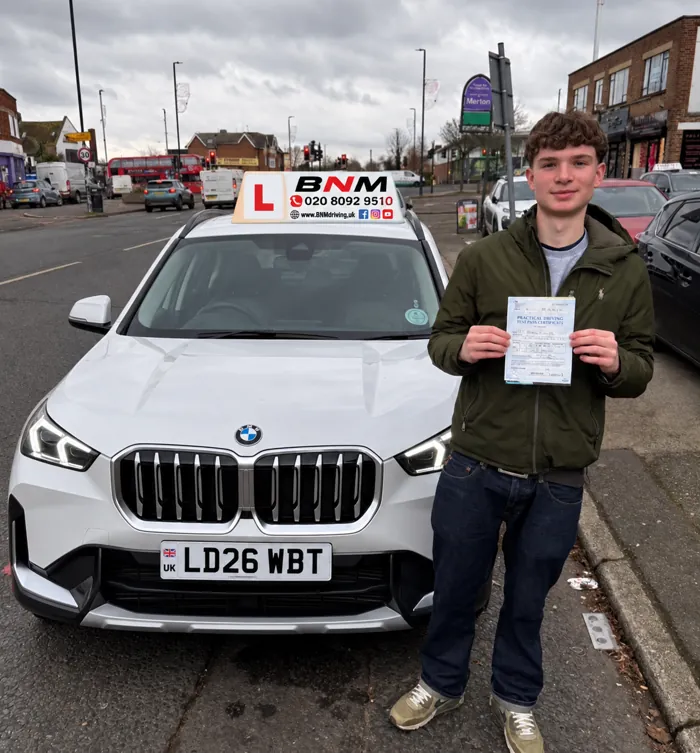
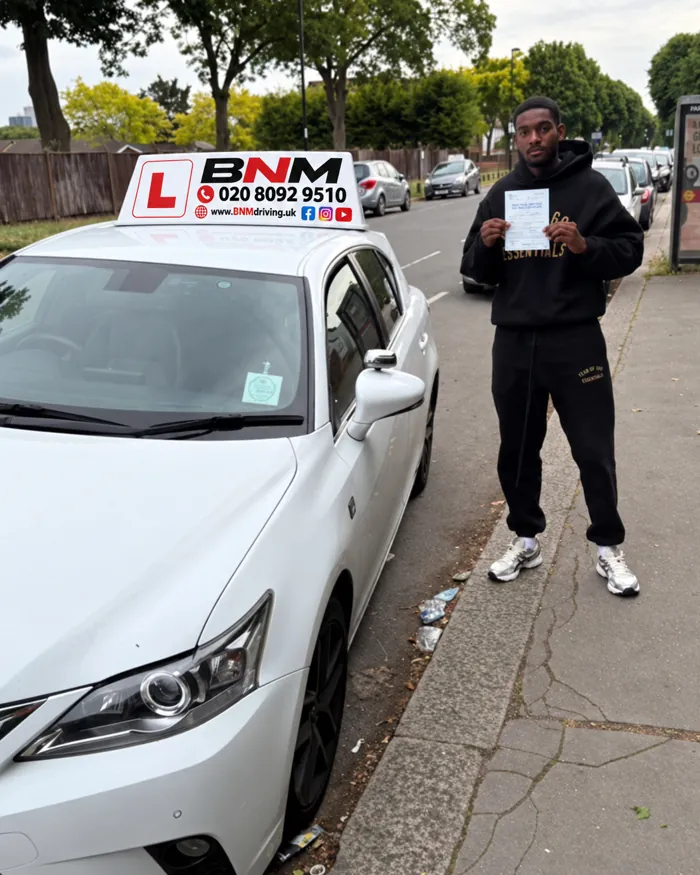
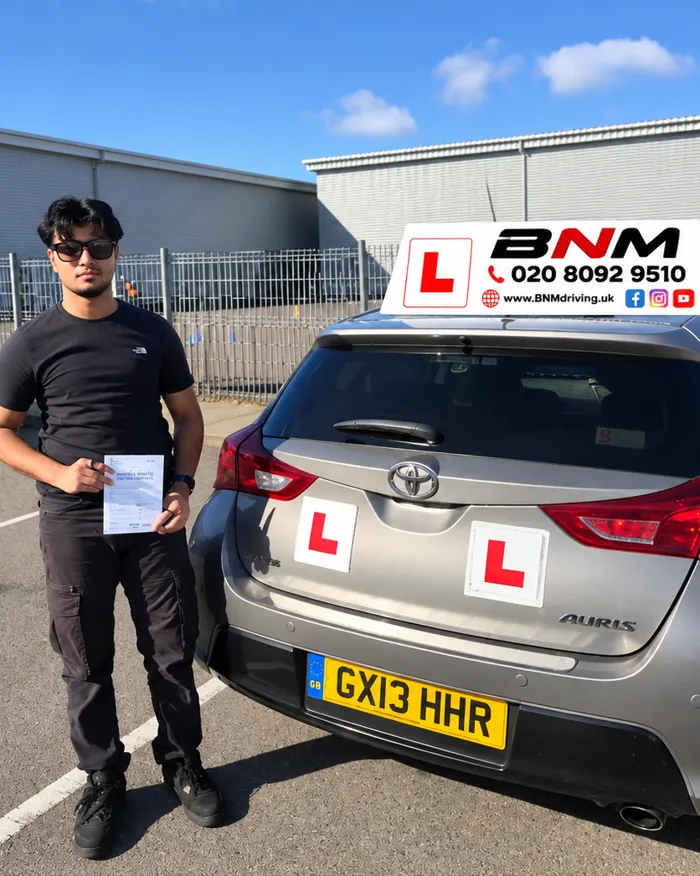
To pass your driving test first time, learn your test centre’s roads, fix the top fail reasons and pass a mock test first. Already have a test date? Our fast-track driving course fits 30 hours of lessons into 1–2 weeks before it, with a mock test on local test routes included. Or book a first lesson for an honest view of how close you are.