Driving lessons for nervous learners work best in 7 steps: tell your instructor, start on quiet roads, learn one skill at a time and add busy South London traffic only when the basics feel routine. Below are the steps, why many nervous learners choose an automatic, how lessons build up and tips for each type of learner. Then come common mistakes, test nerves and how many lessons to plan for.
How to take driving lessons as a nervous learner
To take driving lessons as a nervous learner, follow these 7 steps in order. Each one is explained further down the page:
- Tell your instructor you’re nervousName what worries you most, such as roundabouts, buses or stalling, before the car moves.
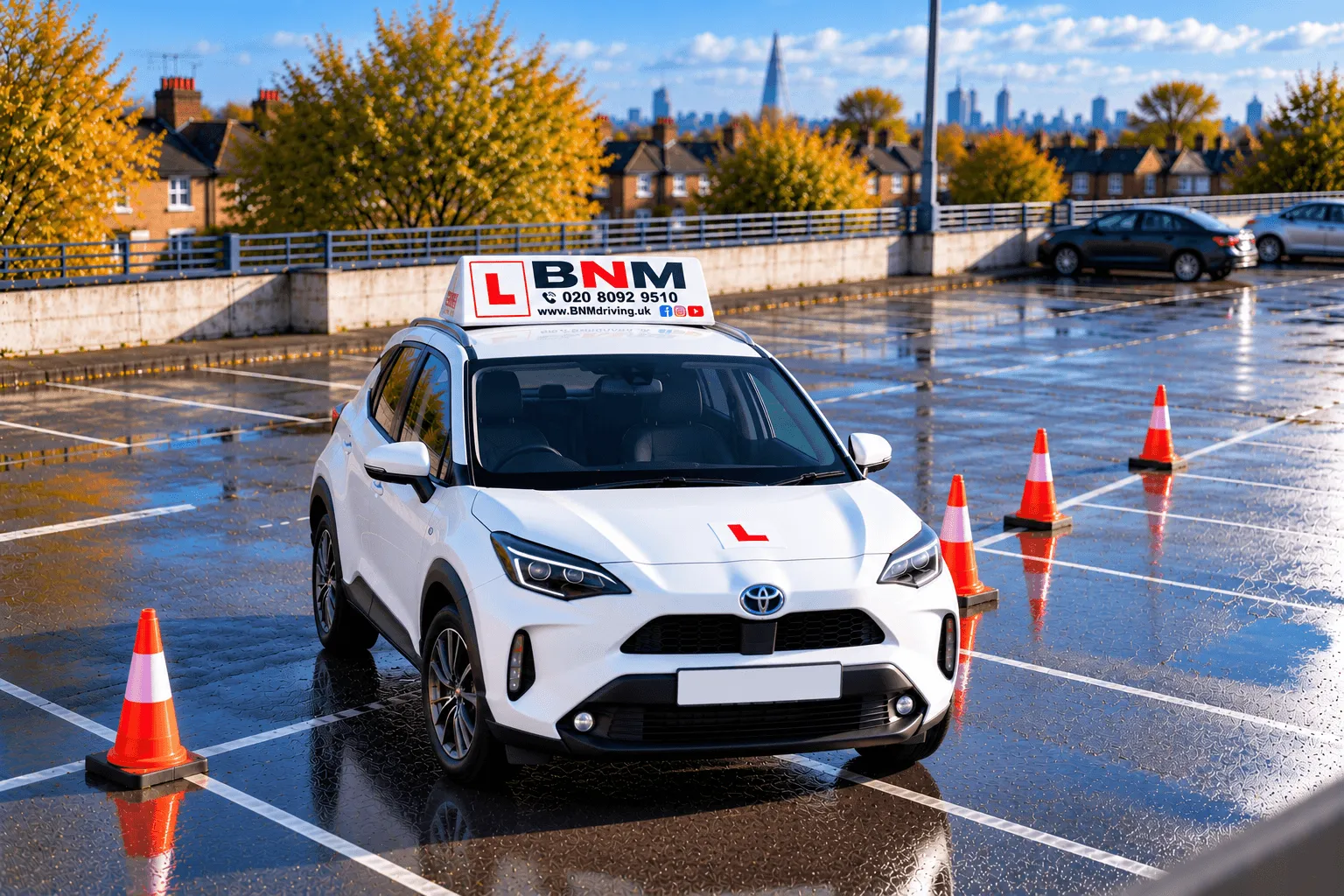
- Start on quiet roadsAn empty car park or a quiet residential street takes traffic out of the first lessons.
- Learn one skill at a timePractise moving off, stopping and steering until they feel routine, then add junctions.
- Choose your gearbox earlyAn automatic removes the clutch and gear changes, which frees attention for the road.
- Book lessons at a steady rhythmWeekly or twice-weekly lessons keep skills fresh, so each lesson starts where the last one ended.
- Agree a pause wordPick a word that means “pull over when it’s safe”, so you always know you can stop.
- Add busy roads in stagesMove to main roads, roundabouts and dual carriageways one at a time, once the stage before feels calm.
Why many nervous learners choose automatic
Many nervous learners choose automatic because it removes 2 tasks: working the clutch and changing gear. An automatic car also can’t stall, which takes away one of the biggest worries at junctions, traffic lights and hill starts. That leaves more attention for mirrors, hazards and other drivers.
Automatics are now common. An AA Driving School analysis of DVSA data found that 29.4% of car tests in Great Britain in 2025–26 were taken in an automatic, up from about 4% in 2007–08.
The trade-off is the licence. Pass in an automatic and you can drive only automatics. Pass in a manual and you can drive both. You can upgrade later by passing a test in a manual car, with no new provisional licence needed (GOV.UK). Manual still suits nervous learners who want the full licence and are happy to spend extra lessons on clutch control.
How lessons build up from quiet roads to London traffic
Lessons for nervous learners build up from quiet roads to London traffic in 4 stages. The table below shows where each stage takes place and what you practise there:
| Stage | Where | What you practise |
|---|---|---|
| 1. Control | An empty car park or quiet residential street | The controls, moving off, stopping and steering |
| 2. Junctions | Quiet residential roads with few parked cars | Turning left and right, emerging and mirror checks |
| 3. Traffic | Busier roads with buses, bus lanes and cycle lanes | Roundabouts, lane choice and meeting oncoming traffic |
| 4. Test routes | Roads around the Mitcham, Morden or Tolworth test centre | Independent driving, manoeuvres and a mock test |
Move up a stage when the current one feels routine, not after a set number of lessons. Going back a stage for one lesson is normal, especially after a break or a bad day.
Stage 1 starts on lesson one. What happens in that first hour is covered in our guide to your first driving lesson as a nervous learner.
What makes London roads harder for nervous learners?
London roads are harder for nervous learners because of 4 local features: bus lanes with set hours, red routes where you can’t stop, cycle lanes beside the kerb and vans double-parked on narrow streets. Your instructor brings these in one at a time at stage 3. In our experience, learners who meet them slowly on quieter South London roads handle them calmly on test day.
Tips for each type of nervous learner
Tips for each type of nervous learner start from a different worry. The 5 learner types below cover teenagers, adults, learners after a setback, learners with anxiety or a condition, and qualified drivers.
Nervous teenagers (17–19)
Nervous teenagers often worry about being judged by friends or parents. Keep your progress private until you feel ready to share it. Private practice with a parent helps once you can control the car. The supervisor must be 21 or over, qualified to drive that type of car and have held a full licence for 3 years (GOV.UK). Our complete beginner’s guide to learning to drive covers the licence, theory test and timeline for South London learners.
Nervous adult learners
Nervous adult learners often know the risks of driving better than teenagers, after years as a passenger. That knowledge makes you a careful driver once the controls feel natural. Evening and weekend lessons fit around work. Many adults choose an automatic, so they learn the road without also learning the clutch.
Learners after a bad lesson or a failed test
Learners after a bad lesson or a failed test need one calm lesson on familiar roads before moving on. Talk through what went wrong, then practise only that skill. After a failed test, your next test must be at least 10 working days away (GOV.UK). If the bad experience came from an instructor who shouted or rushed you, change instructor rather than give up.
Learners with anxiety, ADHD or autism
Learners with anxiety, ADHD or autism benefit from predictable lessons: the same start point, a plan for each lesson and warning before anything new. Feeling nervous isn’t a medical condition. You only need to tell DVLA if you’re diagnosed with anxiety and it affects your ability to drive safely (GOV.UK). Speak to your GP, if nerves stop you sleeping or eating before lessons. Our guide to driving lessons with ADHD, dyspraxia or dyslexia covers test support and DVLA rules for those conditions.
Qualified drivers who lost confidence
Qualified drivers who lost confidence take refresher lessons, not learner lessons. A refresher lesson uses the same dual-control car and targets the roads you avoid, such as motorways, roundabouts or central London. One survey for Aviva (June 2023) found that 1 in 7 UK motorists say anxiety affects their driving, so the worry is common.
Common mistakes nervous learners make
There are 5 common mistakes nervous learners make, and each one keeps the nerves going for longer. They are listed below:
- Hiding the nerves: an instructor who doesn’t know plans a normal-paced lesson.
- Cancelling after a bad lesson: a long gap makes the next lesson feel like the first one again.
- Avoiding hard roads forever: roundabouts and dual carriageways stay scary until you drive them with your instructor.
- Comparing progress with friends: GOV.UK sets no minimum number of lessons, so there’s no “normal” speed.
- Booking the test to get it over with: with 16–23-week waits locally, a fail costs months, so book after a passed mock test.
Every learner stalls, misses a mirror check or takes a wrong turn. Each mistake on a lesson is something to fix, not a sign you can’t drive.
How to manage driving test nerves
To manage driving test nerves, learn the 4 test rules that answer the biggest worries. DVSA’s Ready to Pass campaign says 1 in 10 people who fail the driving test say it was mostly down to nerves. GOV.UK sets out these rules:
- Mistakes: you can carry on after a mistake. The examiner stops the test only if your driving is a danger to other road users.
- Faults: you can make up to 15 driving faults and still pass, with no serious or dangerous faults.
- Company: your instructor can sit in the back, but can’t take part in the test.
- Timing: you can move your test free with at least 10 full working days’ notice, if you don’t feel ready.
The test includes around 35 minutes of driving, with 20–35 minutes of independent driving. The full order of events is on the GOV.UK page about what happens during the driving test. DVSA also lists tips on sleep, caffeine and mindfulness in its guide to managing driving test nerves.
Watching a real test route takes away surprises. The video below shows a full Mitcham test route, filmed by BNM in April 2025:

Choosing a South London test centre
Choosing a South London test centre means weighing a median wait of 16–23 weeks against pass rates of 47–54% (DVSA). The table below shows each centre’s figures:
| Test centre | Pass rate | Wait (weeks) |
|---|---|---|
| Mitcham | 47.0% | 16.1 |
| Morden | 51.0% | 19.1 |
| Tolworth | 53.6% | 23.1 |
Car test pass rates, April 2025 to March 2026: DVSA DRT122A (June 2026). Median wait from booking to test, September 2026: DVSA DRT122F (October 2026). Waits change every month.
Take your test at the centre whose roads you know best. Familiar roads matter more to a nervous learner than a few points of pass rate.
How many lessons do nervous learners need?
Nervous learners need no set number of lessons. GOV.UK sets no minimum, and there’s no official figure for nervous learners. The usual reference point is about 45 hours of lessons plus 22 hours of private practice, from Driving Standards Agency research. Plan around that figure and review progress with your instructor every 10 hours. Our guide to how many driving lessons you need shows how hours vary by learner.
Driving lessons for nervous learners with us
Driving lessons for nervous learners with us start with a 90-minute introductory lesson for new learners. Our 4 DVSA-approved instructors are Syed Nauman Ali, Martin West, Marine Averlan and Paul Wylde. They teach manual and automatic lessons in dual-control cars around the Mitcham, Morden and Tolworth test centres. Tell your instructor what worries you, and the first lesson starts on quiet roads. Lessons after that cost £75 for a 2-hour lesson, or £36.50 an hour when you book a 10-hour block. Qualified drivers can book a 2-hour refresher lesson for £75.
Frequently asked questions
Is it normal to be nervous about learning to drive?
Yes. Nerves are common at every stage of driving. A survey for Aviva (June 2023) found that 1 in 7 UK motorists say anxiety affects their driving.
Should I tell my instructor I’m nervous?
Yes. Tell your instructor before the first lesson, so they start on quiet roads and explain each step before you do it.
Is automatic better for nervous learners?
Yes, for many learners. An automatic removes the clutch and gear changes and can’t stall. The licence then covers automatic cars only.
Can I stop a lesson if I panic?
Yes. Ask your instructor to pull over where it’s safe. Dual controls let your instructor brake at any time, and you carry on when you feel ready.
Can my instructor sit in on my driving test?
Yes. Your instructor, a relative or a friend over 16 can sit in the back. They can’t take any part in the test (GOV.UK).
Do I need to tell DVLA about anxiety?
Only if you’re diagnosed with anxiety and it affects your ability to drive safely. Feeling nervous about driving doesn’t need reporting (GOV.UK).
Can qualified drivers take lessons for nerves?
Yes. Refresher lessons are for full licence holders who lost confidence. They target the roads you avoid, such as motorways or busy roundabouts.
Which South London test centre has the highest pass rate?
Tolworth had the highest pass rate of the 3 local centres, at 53.6% in 2025–26 (DVSA). Morden had 51.0% and Mitcham 47.0%.
Automatic driving lessons for nervous learners in South London
BNM Driving School is a local, independent driving school based in Hackbridge (SM6). Our DVSA-approved instructors teach manual and automatic lessons in dual-control cars across South and South West London. Our learners have a 98% pass rate, and more than 2,000 have passed with us.
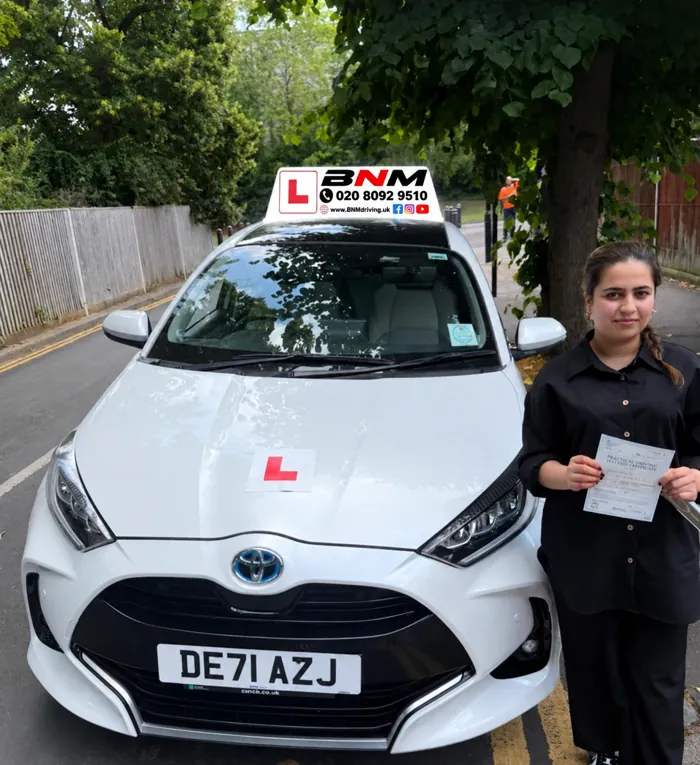
Driving lessons for nervous learners go at your pace, from quiet roads to South London traffic. An automatic car takes 2 tasks off your list and can’t stall. Find out how to learn to drive an automatic with us, or book one of our 90-minute first driving lessons in South London and tell your instructor what worries you.