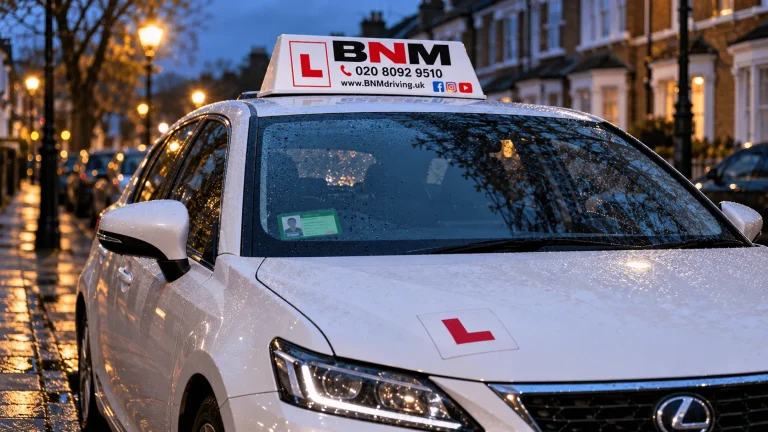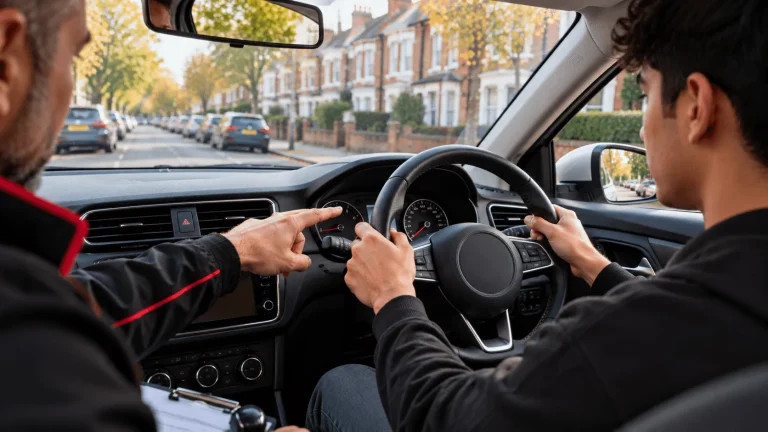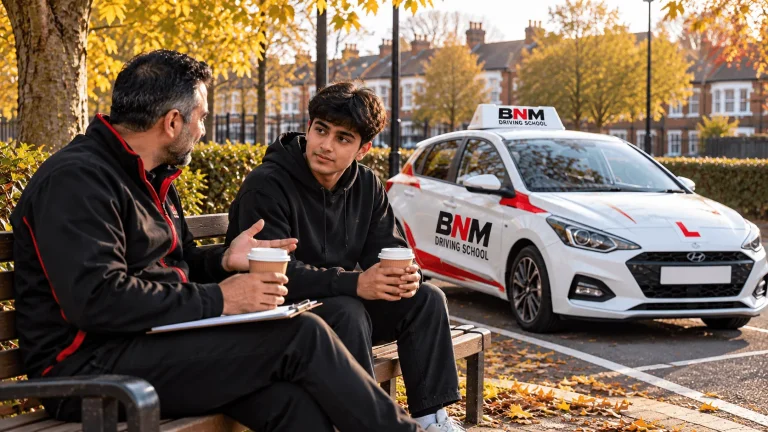
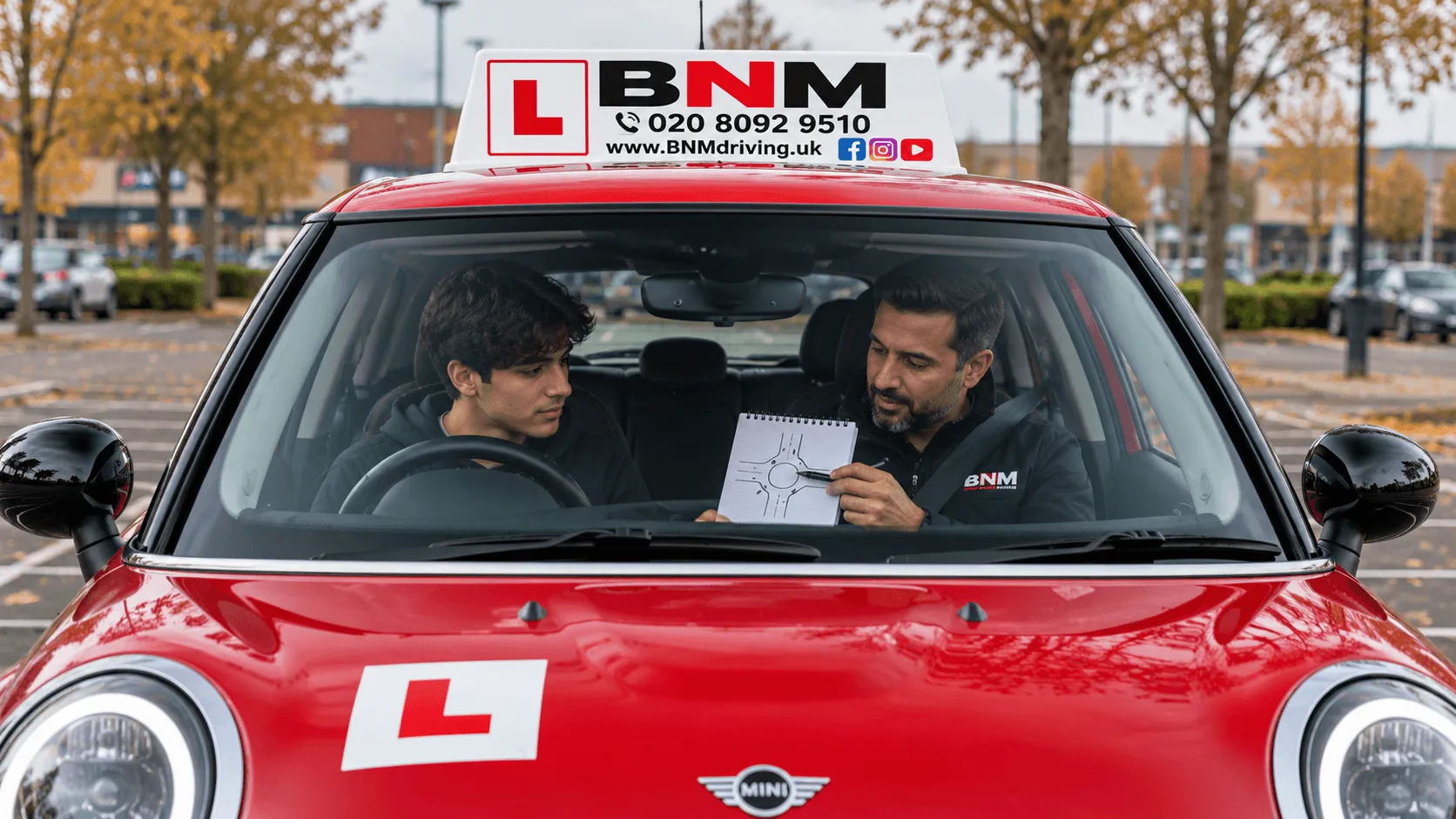
Yes: you can take driving lessons with ADHD, dyspraxia or dyslexia and pass the same driving test as everyone else, using 7 steps that fit your lessons and both tests to how you learn. Below are the steps, the right car and lesson length, what to tell your instructor and tips for each condition. Then come the DVLA rules, theory and practical test support, common mistakes and lesson numbers.
How to learn to drive with ADHD, dyspraxia or dyslexia
To learn to drive with ADHD, dyspraxia or dyslexia, follow these 7 steps in order. Each one is explained further down the page:
- Tell your instructor before lesson oneName the condition and what helps you, such as short instructions, diagrams or planned breaks.
- Check the DVLA rule for your conditionMost learners don’t need to tell DVLA. ADHD and autism need form A1 only if a doctor says your driving is affected.
- Choose your gearbox earlyAn automatic removes the clutch and gear changes, which frees attention for the road.
- Match lesson length to your focusBook lessons for the time of day you concentrate best, with a planned stop halfway.
- Learn one skill at a timePractise each skill on quiet roads until it feels routine, then add traffic.
- Ask for theory test support when you bookAudio is open to everyone. Extra time, a reader and reworded questions need proof.
- Tell DVSA when you book your driving testThe examiner can adjust directions, timing and the eyesight check.
Choosing the right car and lesson length
Choosing the right car and lesson length decides how many tasks you handle at once. These are the 2 choices that change your lessons most, so make them before you book a block.
Manual or automatic?
An automatic car removes 2 tasks: working the clutch and changing gear. That leaves more attention for mirrors, junctions and hazards. IAM RoadSmart recommends trying an automatic for learners with dyspraxia, because it needs less co-ordination.
Automatics are now common. An AA Driving School analysis of DVSA data found that 29.4% of car tests in Great Britain in 2025–26 were taken in an automatic. The trade-off is the licence. Pass in an automatic and you can drive only automatics. Pass in a manual and you can drive both. You can upgrade later by passing a test in a manual car, with no new provisional licence needed (GOV.UK). Our comparison of manual vs automatic lessons covers the choice in detail.
How long should each lesson be?
Each lesson should last as long as you can stay focused, plus a short break. A 2-hour lesson suits many learners when it includes a 5–10-minute stop at the kerb halfway through. Ask for a stop every 40–45 minutes, if you tire sooner.
Book lessons for the time of day you concentrate best. In our experience, a weekly lesson at the same time and from the same start point builds routine faster than irregular slots. If you take medication, ask your doctor which hours of the day suit driving.
What should you tell your instructor before the first lesson?
Tell your instructor 5 things before the first lesson, so the lesson plan fits you from the start. The list below covers what to share:
- Your conditionADHD, dyspraxia, dyslexia, autism or a mix, diagnosed or suspected.
- Your learning styleSpoken steps, a drawn diagram or watching a demonstration first.
- Your overload triggersSeveral instructions at once, the radio, busy junctions or sudden changes of plan.
- Your best time of dayThe hours you focus best, including medication timing if you choose to share it.
- Your feedback preferenceA short written or texted summary after each lesson helps you remember what you covered.
You don’t have to share medical details. In our experience, a 2-minute conversation at the start of the first lesson shapes every lesson after it.
How lessons adapt to ADHD, dyspraxia, dyslexia and autism
Lessons adapt differently for each of these 4 conditions, because each one affects a different part of driving. The table below shows the part of driving each condition affects and the adjustment that usually helps:
| Condition | Affects | What helps |
|---|---|---|
| ADHD | Attention, impulse control, staying alert on quiet roads | Single instructions, a fixed routine, commentary driving |
| Dyspraxia | Co-ordination, telling left from right, judging space | An automatic car, extra repetition, a left-hand marker |
| Dyslexia | Reading signs, remembering a sequence of directions | Diagrams, one direction at a time, audio theory test |
| Autism | Coping with change, busy sensory scenes, unwritten road habits | The same car and routes at first, warning before anything new |
Many learners have more than one of these conditions, so combine the adjustments that fit you.
Learning to drive with ADHD
Learning to drive with ADHD goes best with a fixed routine and one instruction at a time. Commentary driving helps: you say aloud what you see and what you plan to do, which keeps your attention on the road. Clear distractions before you move off, such as putting your phone out of sight.
A 2017 study in JAMA Psychiatry (Chang et al.) looked at crash-related emergency visits by people with ADHD. In months they took medication, visits fell by 38% for men and 42% for women. The study used US insurance data from 2005 to 2014. Medication is a decision for you and your doctor, but plan lessons for the hours it works best. GOV.UK’s drug-driving rules name dexamphetamine. You can drive on it if it’s prescribed, you follow your healthcare professional’s advice and it doesn’t make you unfit to drive.
Learning to drive with dyspraxia
Learning to drive with dyspraxia takes more repetition, because tasks like steering while signalling take longer to become automatic. Practise each manoeuvre in the same car park until it feels routine, then move it onto the road. A band on your left wrist helps, if left and right get muddled under pressure. IAM RoadSmart also suggests writing directions down and planning stops on longer drives.
Learning to drive with dyslexia
Learning to drive with dyslexia mainly affects 3 things: reading signs at speed, remembering a run of directions and the theory test. Ask your instructor for one direction at a time, and for a quick sketch of a junction before you drive it. Road signs work by shape first. Circles give orders, triangles warn and rectangles inform, so you rarely need to read the words at speed.
Learning to drive with autism
Learning to drive with autism goes best with predictability: the same car, a lesson plan and warning before anything new. Start on 2–3 familiar routes, then add one new road at a time. Ask your instructor to explain the unwritten habits of other drivers. Under rule 110 of the Highway Code, flashing headlights should only mean “I am here”. Many drivers use it to say “go ahead” instead.
Do you need to tell DVLA?
Learner drivers usually don’t need to tell DVLA about ADHD or autism, and never need to for dyslexia. You must tell DVLA when a doctor says your condition or its medication affects your ability to drive safely. The table below shows the GOV.UK rule for each condition:
| Condition | Tell DVLA as a learner? |
|---|---|
| ADHD | Only if a doctor says ADHD or its medication affects safe driving. Use form A1. |
| Autism | Only if a doctor says autism affects safe driving. Use form A1. |
| Dyslexia | No. GOV.UK says learning difficulties such as dyslexia don’t need reporting. |
| Dyspraxia | GOV.UK doesn’t name it. Ask your doctor whether it affects safe driving. |
Rules from GOV.UK condition pages for ADHD, autism and learning disabilities (checked October 2026).
You can be fined up to £1,000 for not telling DVLA about ADHD that affects your ability to drive safely. You may also be prosecuted after an accident. The full rule is on the GOV.UK page about ADHD and driving. The duty continues after you pass: tell DVLA if your condition changes in a way that affects safe driving. If you do tell DVLA, tell your car insurer too.
Where to get a driving assessment
You can get a driving assessment at a centre accredited by Driving Mobility, a national charity with about 20 member centres. An occupational therapist and an ADI assess whether a condition affects your driving. The nearest centre for South London learners is QEF Mobility Services in Carshalton (SM5), which takes self-referrals. Costs depend on the type of assessment, so ask when you book. Driving Mobility says its occupational therapists also write reports that neurodivergent learners can use to request theory test support.
What help can you get on the theory test?
You can get 4 types of support on the theory test if you have a reading difficulty such as dyslexia. GOV.UK lists them as follows:
- Audio: hear the test through headphones in English or Welsh, and replay questions as often as you need. No proof is needed.
- Extra time: more time for the multiple-choice questions. Proof is needed.
- A reader: a staff member reads the questions aloud and records your answers. Proof is needed.
- Rewording: a staff member rewords questions in simpler language, but not the technical terms. Proof is needed.
Proof can be an email, letter or report from 4 sources: a teacher, a doctor, an occupational therapist or an online dyslexia screening product. Tell DVSA about your reading difficulty when you book, and it’ll explain how to send proof. DVSA then decides which support you get. The steps are on the GOV.UK page about theory test support for reading difficulties.
The car theory test costs £23, and the pass certificate lasts 2 years (GOV.UK). For ADHD or another condition that isn’t a reading difficulty, contact DVSA on 0300 200 1122 before you book.
Passing hazard perception with ADHD
Passing hazard perception with ADHD depends on controlled clicking. The test has 14 video clips, and each developing hazard scores up to 5 points (GOV.UK). You need 44 out of 75 to pass, plus 43 out of 50 on the multiple-choice part. You score nothing on a clip if you click continuously or in a pattern. Practise clicking once when a hazard starts to develop, then once more as it grows. Extra time covers the multiple-choice questions only, so hazard perception is the part to practise most.
How does DVSA adjust the practical test?
DVSA adjusts the practical test when you say at booking that you have a disability, health condition or learning difficulty. You drive to the same standard as everyone else, but the examiner can change how the test runs. The 3 adjustments GOV.UK lists are:
- Directions: during independent driving, the examiner can ask whether you’d prefer to follow traffic signs rather than a sat nav.
- Time: the examiner can allow extra time for instructions and directions.
- Eyesight check: you can write down the number plate instead of reading it aloud.
The test includes around 35 minutes of driving, with 20–35 minutes of independent driving. A wrong turning is not a fault: the examiner helps you rejoin the route (GOV.UK). That rule takes a lot of pressure off learners who mix up directions.
The video below shows a real driving test route from Morden test centre, filmed by BNM in January 2024. The independent driving part follows road signs instead of a sat nav, the option the examiner can offer learners with a learning difficulty:

Planning your test day
Plan your test day around 4 choices that cut down surprises. They are listed below:
- Test time: book a slot at the time of day you drive best.
- Car: take the test in the car you learned in, so the controls feel familiar.
- Warm-up: have a lesson just before the test on roads near the centre.
- Directions: ask the examiner to repeat a direction if you miss it.
Taking your test at Mitcham, Morden or Tolworth
Taking your test at Mitcham, Morden or Tolworth means a median wait of 16–23 weeks from booking (DVSA, September 2026). The table below shows each centre’s wait and pass rate:
| Test centre | Pass rate | Wait (weeks) |
|---|---|---|
| Mitcham | 47.0% | 16.1 |
| Morden | 51.0% | 19.1 |
| Tolworth | 53.6% | 23.1 |
Car test pass rates, April 2025 to March 2026: DVSA DRT122A (June 2026). Median wait from booking to test, September 2026: DVSA DRT122F (October 2026). Waits change every month.
Use the wait to practise on the roads around your centre. Familiar layouts mean fewer surprises on test day, which helps learners who find new situations tiring.
Common mistakes when learning to drive with ADHD, dyspraxia or dyslexia
There are 5 common mistakes that slow learners with ADHD, dyspraxia or dyslexia down. They are listed below:
- Hiding the condition: an instructor who doesn’t know may read slow progress as lack of effort.
- Booking lessons when tired: a lesson at a low-focus time of day repeats the last one instead of moving on.
- Rushing into heavy traffic: busy roads before the controls feel automatic overload attention.
- Booking the test too early: with 16–23-week waits locally, a fail costs months, so book after a passed mock test.
- Staying with an instructor who doesn’t adapt: one who won’t change how they explain things wastes your hours.
If you’ve had about 10 hours with no clear progress, read our guide on how to choose a driving instructor. It lists 8 checks, including how an instructor teaches and gives feedback.
How many lessons do learners with ADHD, dyspraxia or dyslexia need?
Learners with ADHD, dyspraxia or dyslexia need no set number of lessons. GOV.UK sets no minimum, and there’s no official figure for neurodivergent learners. The usual reference point is about 45 hours of lessons plus 22 hours of private practice, from Driving Standards Agency research. Plan around that figure and review progress with your instructor every 10 hours. Our guide to the driving lessons you need to pass shows how hours vary by learner.
Private practice with a parent
Private practice with a parent works best when it repeats the routes and words your instructor uses. The supervisor must be 21 or over, qualified to drive that type of car and have held a full licence for 3 years (GOV.UK). You also need learner insurance on that car. Ask your instructor which skill to practise each week, and keep sessions short at first.
Learning to drive with us
Learning to drive with us starts with a 90-minute introductory lesson for new learners. All 4 of our instructors have taught learners with ADHD, dyspraxia, dyslexia and autism: Syed Nauman Ali, Martin West, Marine Averlan and Paul Wylde. Tell your instructor what helps you learn: short instructions, diagrams, more breaks or the same route each week. Our DVSA-approved instructors teach manual and automatic lessons in dual-control cars around the Mitcham, Morden and Tolworth test centres. Lessons after that cost £75 for a 2-hour lesson, or £36.50 an hour when you book a 10-hour block.
Frequently asked questions
Can you learn to drive with ADHD?
Yes. People with ADHD learn to drive and pass the standard test. Learners usually don’t need to tell DVLA, unless a doctor says ADHD or its medication affects safe driving.
Do I have to tell DVLA I have dyslexia?
No. GOV.UK says you don’t need to tell DVLA about learning difficulties such as dyslexia.
Do I have to tell my driving instructor about ADHD?
No, it isn’t a legal requirement. Telling your instructor before the first lesson lets them adapt instructions, lesson length and breaks to how you learn.
Can you get extra time on the theory test for dyslexia?
Yes. Ask for extra time on the multiple-choice questions when you book. DVSA asks for proof, such as a letter from a teacher, doctor or occupational therapist.
Is an automatic easier with dyspraxia?
Yes. An automatic removes the clutch and gear changes, so there are fewer co-ordination tasks. The licence then covers automatic cars only.
Can I drive on ADHD medication?
Yes, if it’s prescribed, you follow your healthcare professional’s advice and it doesn’t make you unfit to drive. GOV.UK’s drug-driving rules name dexamphetamine, so ask your doctor about timing.
Do South London test centres make adjustments?
Yes. Mitcham, Morden and Tolworth follow the same DVSA rules as every centre. Say you have a learning difficulty when you book, and the examiner can adjust the test.
Is there a driving assessment centre near South London?
Yes. QEF Mobility Services in Carshalton (SM5) is accredited by Driving Mobility. An occupational therapist and an ADI assess whether a condition affects your driving.
Automatic driving lessons for learners with ADHD, dyspraxia or dyslexia in South London
BNM Driving School is a local, independent driving school based in Hackbridge (SM6). Our DVSA-approved instructors teach manual and automatic lessons in dual-control cars across South and South West London. Our learners have a 98% pass rate, and more than 2,000 have passed with us.
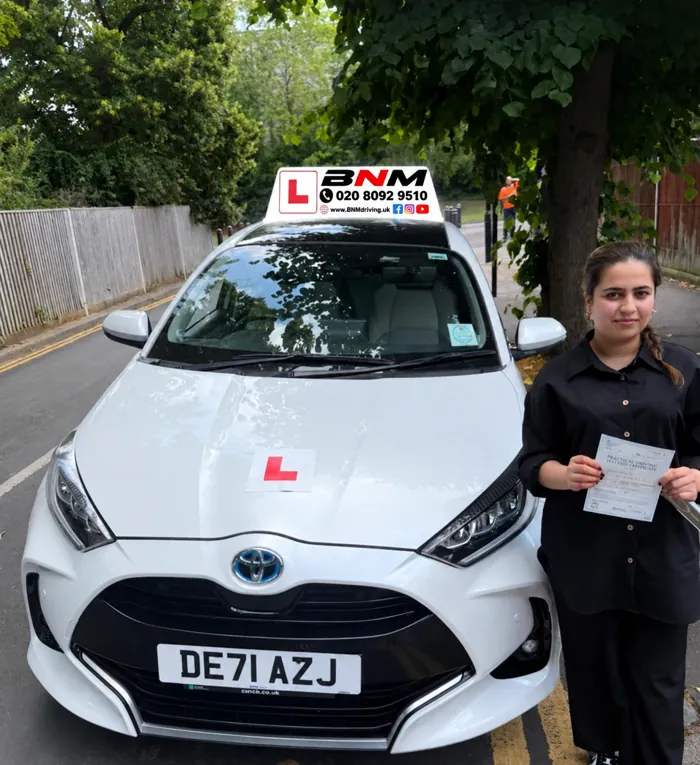
Driving lessons with ADHD, dyspraxia or dyslexia lead to the same driving test as everyone else. An automatic car takes 2 tasks off your list. Find out more about our automatic lessons in South London, or book a 90-minute first lesson and tell your instructor how you learn.