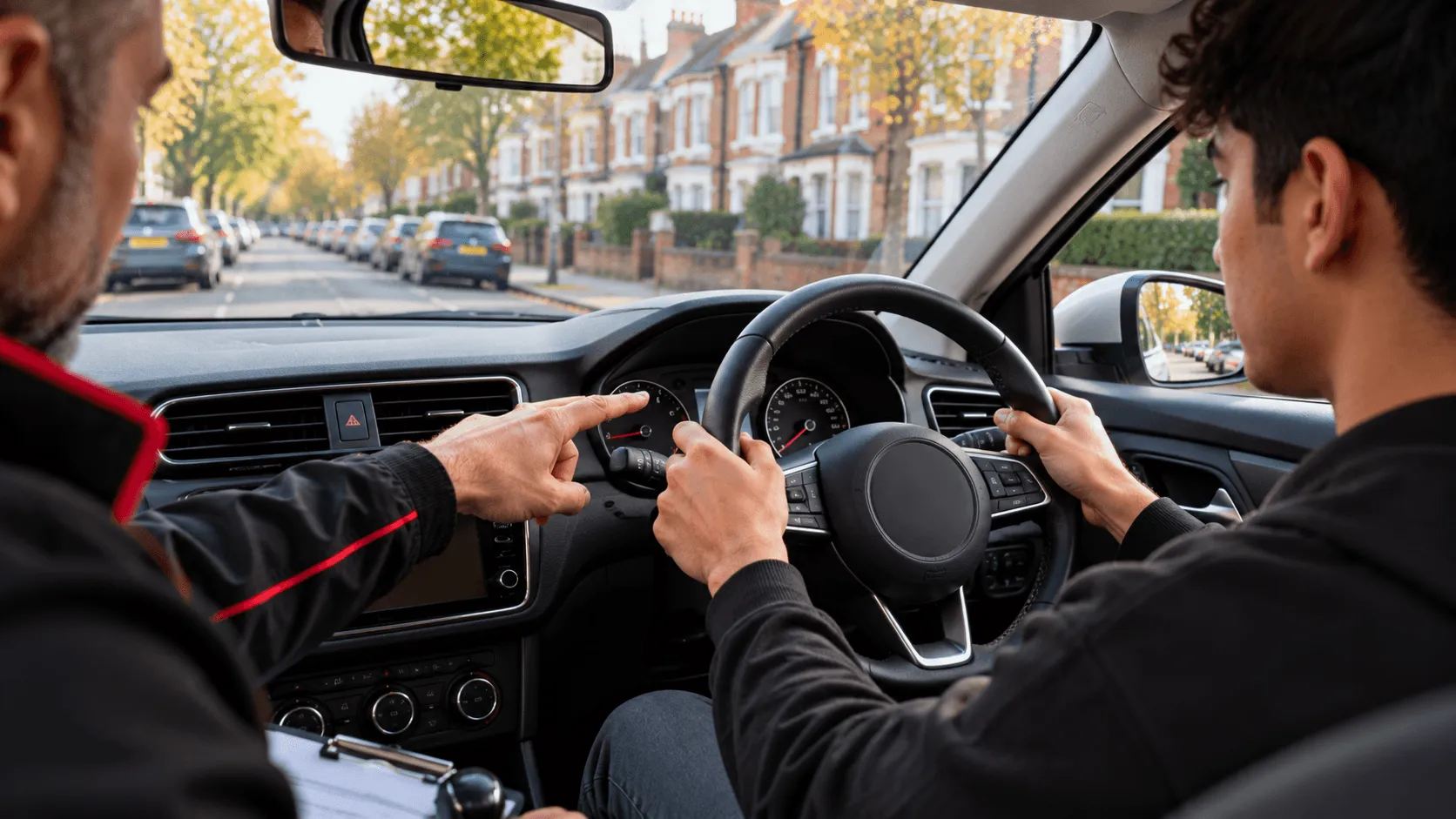
Your first driving lesson usually lasts 1–2 hours: a licence and eyesight check, the car’s controls on a quiet road, then moving off and stopping on your own. Below are the steps, what to bring, what you need beforehand, how nerves and London roads change things, common mistakes and what happens next.
What happens on your first driving lesson, step by step
Your first driving lesson follows 7 steps, from the paperwork to your first drive. The order below is how most instructors run lesson one:
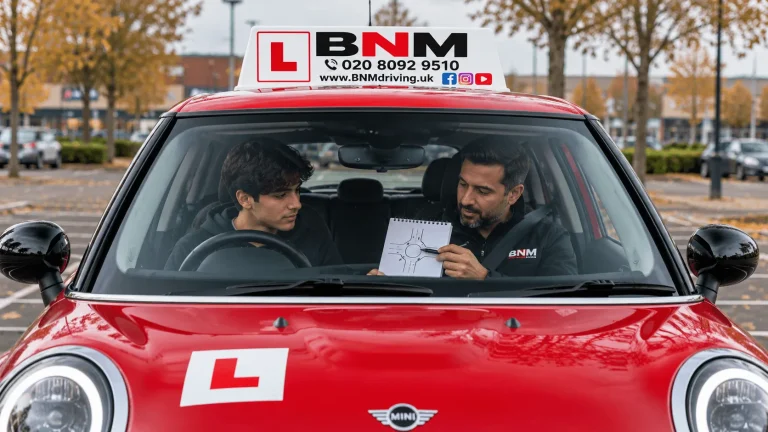
- Licence and eyesight checkYour instructor checks your provisional licence and asks you to read a number plate from 20 metres.
- A quiet starting pointThe lesson starts on a quiet road or in an empty car park, away from traffic.
- The cockpit drillYou set the seat, steering wheel, head restraint and mirrors, and put on your seatbelt.
- The controlsYour instructor explains the pedals, steering, indicators, handbrake and, in a manual, the gears.
- Moving off and stoppingYou check your mirrors and blind spot, move off, then pull up at the kerb.
- A short driveIf the first steps go well, you drive along quiet roads and practise more stops.
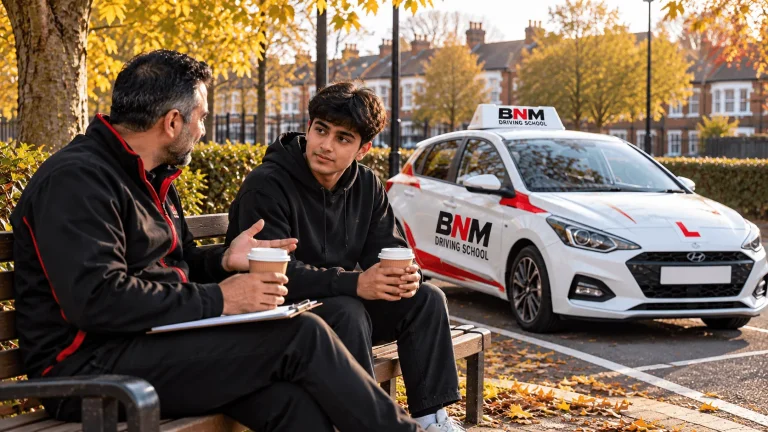
- A debriefYour instructor recaps what you did well and what comes next lesson.
The pace is set by you, not a checklist. Some learners reach step 6 in the first hour, and others spend the whole lesson on steps 3–5.
What to bring to your first driving lesson
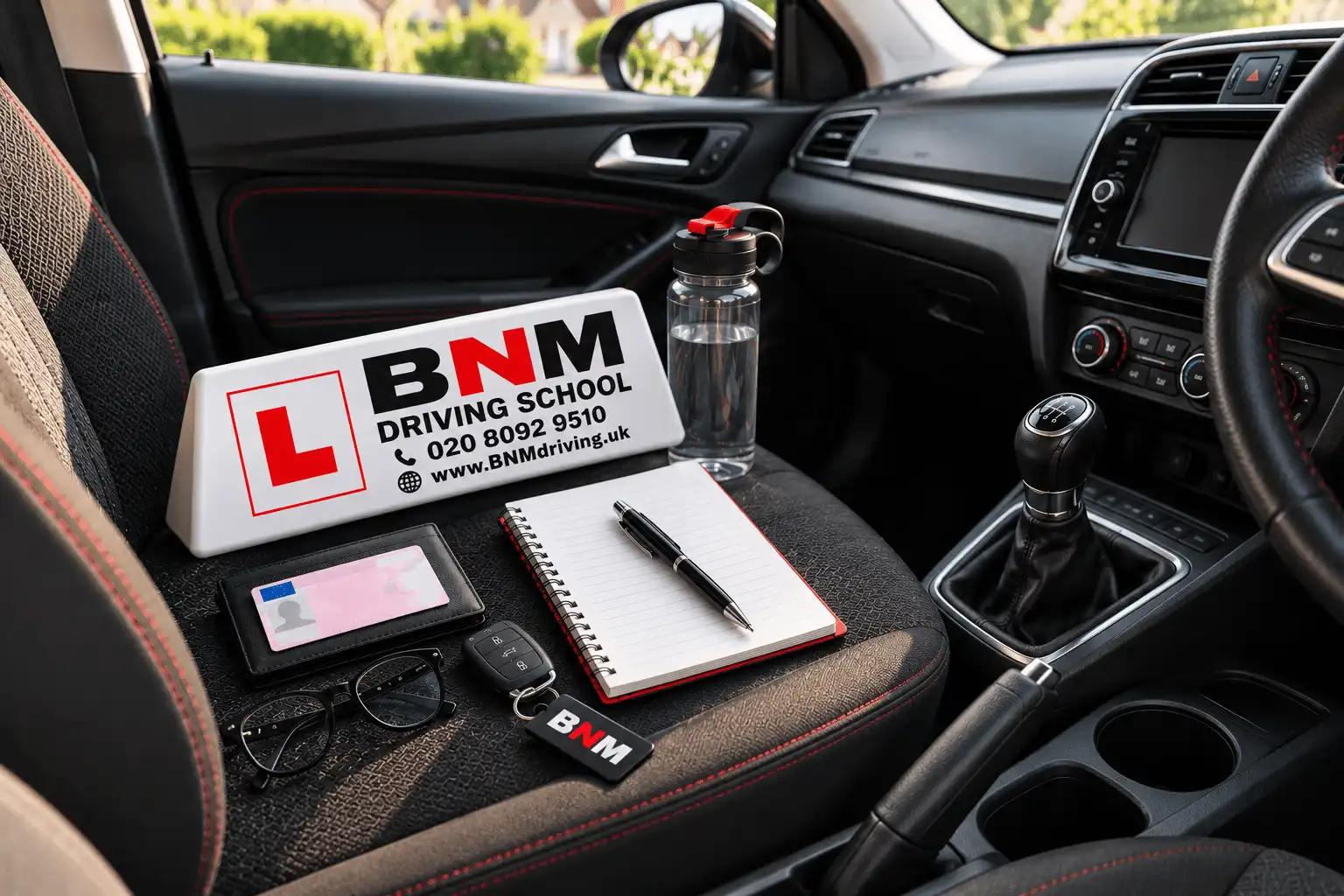
Bring 5 things to your first driving lesson. The checklist below covers everything you need:
- Your provisional licenceThe photocard. Your instructor needs to see it before you drive on the road.
- Glasses or contact lensesWear them, if you need them to read a number plate at 20 metres.
- Flat, thin-soled shoesTrainers let you feel the pedals. Avoid heels, heavy boots and flip-flops.
- A bottle of waterConcentrating for 1–2 hours is more tiring than it sounds.
- Your questionsWrite down anything you want to ask about lessons, tests or costs.
Comfortable clothes help too. A thick coat makes it harder to turn and check your blind spot.
What do you need before your first lesson?
Before your first lesson you need a provisional driving licence, and you need to be 17 or over to drive a car on the road. You can apply for a provisional licence from 15 years and 9 months. It costs £34 online and usually arrives within one week (GOV.UK).
You also need to meet the eyesight standard: reading a number plate from 20 metres, with glasses or contact lenses if you use them. GOV.UK sets out the full driving eyesight rules. You don’t need to pass your theory test first. DVSA surveys from July 2024 to April 2025 found that learners with no lessons before their theory test were 25% more likely to fail their driving test first time.
The rest of the journey, from choosing an instructor to booking your test, is covered in our beginner’s guide to learning to drive in South London.
Will you drive on your first lesson?
Yes, you’ll almost certainly drive on your first lesson. Most learners move off and stop several times, and many finish with a short drive on quiet roads. Lessons where the car never moves are rare.
Your instructor’s car has dual controls, so your instructor has a brake (and in a manual, a clutch) on their side. They can stop the car at any moment. You won’t be asked to drive on a main road until you can move off, steer and stop with confidence.
First lesson in a manual or an automatic
A first lesson in a manual spends more time on the clutch, because moving off needs the biting point. Picture the clutch as a dial between “off” and “on”: the biting point is the moment the car starts to pull. Expect a few stalls on lesson one, which is normal and harmless at low speed.
A first lesson in an automatic skips the clutch and gears. You learn the gear selector (park, reverse, neutral and drive) and keep your right foot on the brake. This leaves more time for steering, mirrors and short drives. Still deciding? Our guide to manual vs automatic driving lessons compares the two.
Your first driving lesson as a nervous learner
As a nervous learner, your first driving lesson goes at your pace, with nothing on a main road. There are 4 things that make lesson one easier:
- Tell your instructor: say you’re nervous at the start, so they plan a slower lesson.
- Ask for a quieter start: an empty car park or a quiet estate road takes traffic out of the picture.
- Trust the dual controls: your instructor can brake for you at any time.
- Book a longer first lesson: 90 minutes to 2 hours leaves time to settle in before you drive.
The second lesson usually feels easier, because the car, the controls and your instructor are already familiar.
First driving lessons in London: what’s different?
First driving lessons in London differ from lessons in quieter towns in 4 ways. Instructors plan around each one:
- 20 mph streets: many residential roads have a 20 mph limit, which suits early lessons.
- Parked cars: narrow terraced streets with cars on both sides mean more waiting for oncoming traffic.
- Cyclists and buses: you’ll learn to check for cyclists before moving off and give buses room.
- Busy main roads: roads like the A23 and A24 have bus lanes and red routes, so they come weeks later.
Across South London, the first few lessons stay on quiet residential roads. Busier junctions and roundabouts follow once moving off, stopping and steering are steady.
Common first-lesson mistakes
There are 5 common mistakes learners make on a first lesson. All are easy to avoid:
- Forgetting your licence: without it, the lesson can’t go on the road.
- Wearing the wrong shoes: heavy boots and heels make it hard to feel the pedals.
- Skipping meals: 1–2 hours of concentration on an empty stomach drains your focus.
- Comparing yourself with friends: every learner starts differently, and lesson one isn’t a test.
- Staying quiet: ask when something isn’t clear, because that’s what the lesson is for.
Stalling, kangaroo starts and wide turns aren’t mistakes on lesson one. They’re part of learning, and instructors expect them.
What happens after your first lesson?
After your first lesson, your instructor gives you an honest estimate of how many hours you’ll need and suggests a lesson plan. The average learner takes about 45 hours of lessons to pass, according to Driving Standards Agency research. Our guide to how many driving lessons you need shows how that varies by learner.
Most learners then book a regular weekly slot, often 2 hours, so skills build from one lesson to the next. Weekly lessons in the first month matter most, because gaps of 2–3 weeks mean relearning the basics.
Your first lesson with us
Your first lesson with us is a 90-minute introductory lesson for new learners, with a DVSA-approved instructor in a dual-control car. It’s built around 4 goals:
- Meet your instructorGet to know the person who’ll teach you, and ask anything.
- Get used to the carLearn the controls in the car you’ll be learning in.
- Try manual or automaticFind out which gearbox suits you before you book more lessons.
- Get an honest planLeave with an estimate of your hours and what comes next.
The £55 introductory lesson has no obligation to book more. BNM is based in Hackbridge (SM6) and teaches across South and South West London.
Frequently asked questions
How long is a first driving lesson?
Most first driving lessons last 1–2 hours. BNM’s introductory lesson is 90 minutes, which leaves time for the controls and a first drive.
Do you drive on your first driving lesson?
Yes. Most learners move off and stop several times, and many finish with a short drive on quiet roads.
Can I have driving lessons before my theory test?
Yes. You only need a provisional licence. DVSA found that learners with no lessons before their theory test were 25% more likely to fail their driving test first time.
Is it normal to be nervous before a first driving lesson?
Yes. Most learners feel nervous before lesson one. Tell your instructor, and they’ll start somewhere quiet and go at your pace.
Will my first lesson in South London be on busy roads?
No. First lessons in South London start on quiet residential roads. Main roads like the A23 and A24 come once you can move off, steer and stop with confidence.
What happens if I forget my provisional licence?
The lesson usually can’t go on the road. Your instructor needs to see your licence before you drive, so keep the photocard with your keys the night before.
Your first driving lesson and driving lesson prices at BNM
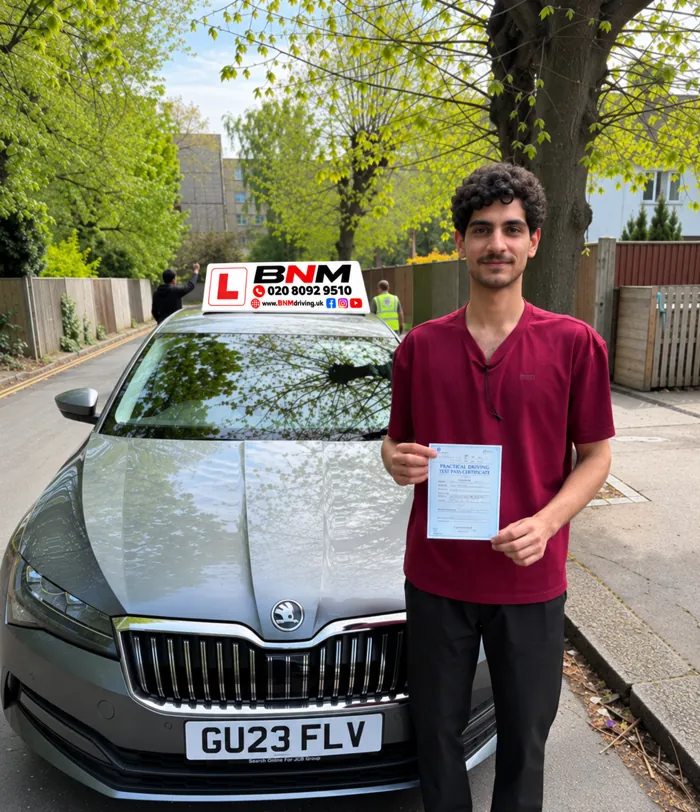
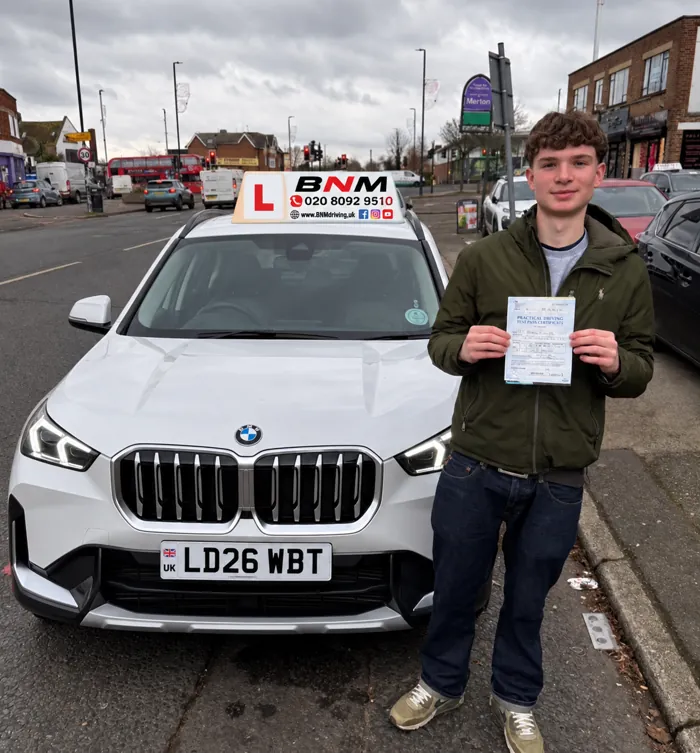
BNM Driving School is a local, independent driving school based in Hackbridge (SM6). We teach manual and automatic lessons in dual-control cars across South and South West London. Lessons cover the routes around the Mitcham, Morden and Tolworth test centres. Our learners have a 98% pass rate, and more than 2,000 have passed with us. Your first driving lesson with us starts on quiet roads, at your pace, with moving off and stopping.
Planning beyond lesson one? See our driving lesson prices for 2-hour lessons, 10 and 20-hour blocks and the intensive course. Or start with a 90-minute first lesson and an honest plan for your hours.