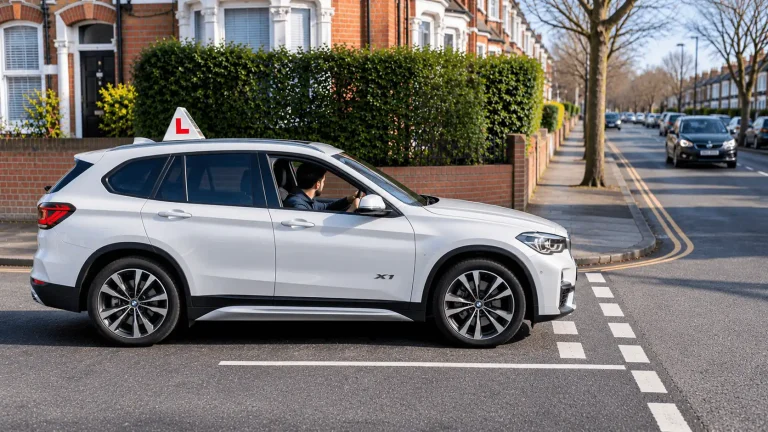
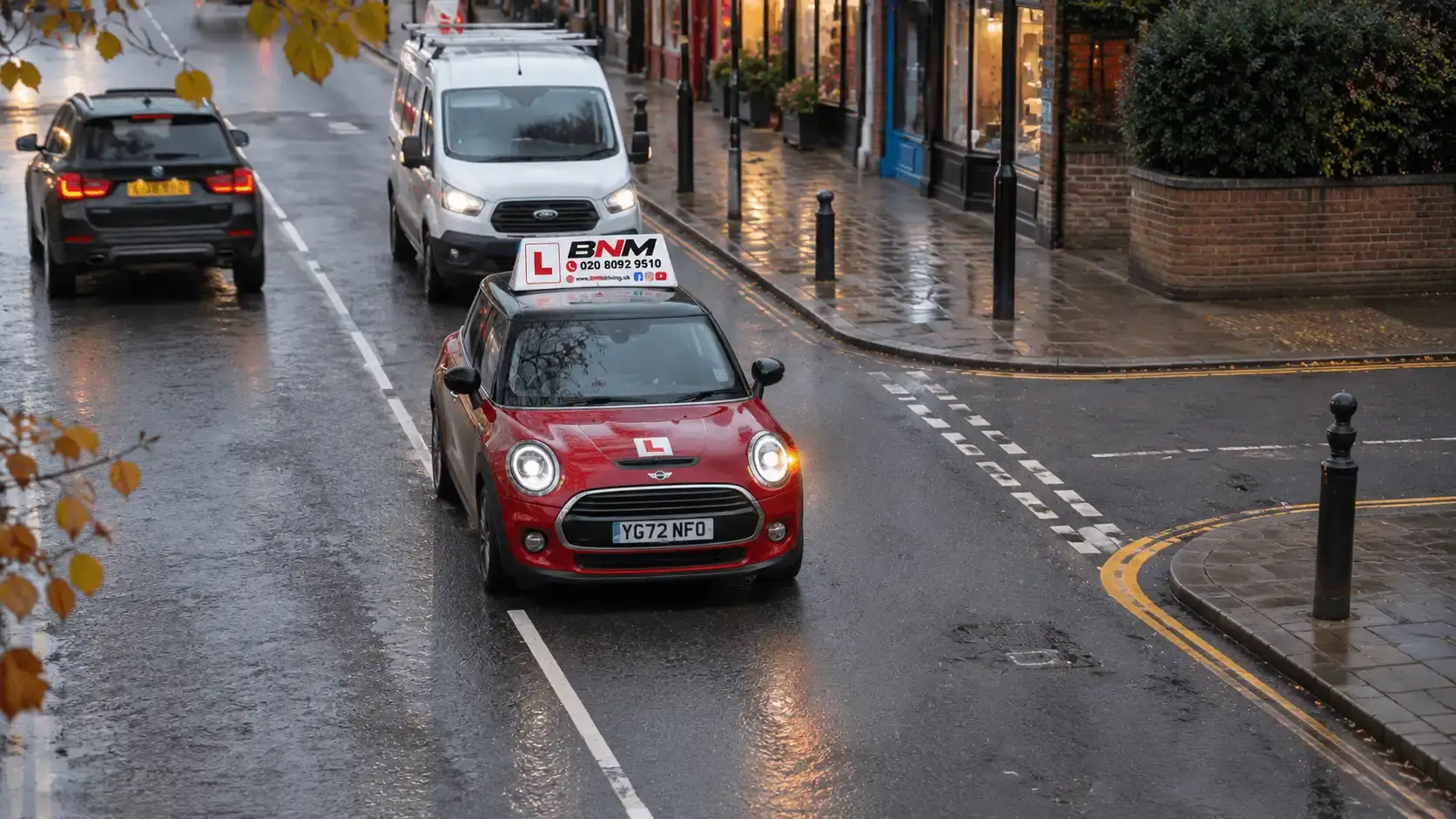
The most common reason for failing the driving test is poor observation at junctions, number 1 on all 19 DVSA top 10 lists since 2007-08. The 2025-26 top 10 falls into 4 groups: looking, positioning, signs and signals, and speed. Below is what each of the 10 reasons for failing looks like on test, why learners make it, and a drill that trains it out. Then come 19 years of DVSA data, the fails that happen before you drive, and a self-check that shows which group to train first.
The 10 most common reasons for failing in 2025-26
The 10 most common reasons for failing in 2025-26 are listed below in DVSA’s order. The table also shows the group each one belongs to and how its rank moved since 2024-25:
| Rank | Reason for failing | Group | Since 2024-25 |
|---|---|---|---|
| 1 | Junctions: observation | Looking | No change |
| 2 | Mirrors: changing direction | Looking | No change |
| 3 | Junctions: turning right | Positioning | Up 1 |
| 4 | Signs: traffic lights | Signs and signals | Up 1 |
| 5 | Control: steering | Positioning | Up 1 |
| 6 | Moving off: safely | Looking | Down 3 |
| 7 | Signs: road markings | Signs and signals | No change |
| 8 | Signs: traffic signs | Signs and signals | No change |
| 9 | Positioning: normal driving | Positioning | No change |
| 10 | Progress: appropriate speed | Speed | New (replaced use of speed) |
Source: DVSA table DRT121F, top 10 faults in car driving tests, published 25 June 2026. Ranks cover April 2025 to March 2026 and the year before. Groups are our own.
Moving off safely fell from 3rd to 6th, the biggest move in the list. The 10th place changed meaning: in 2024-25 it recorded driving too fast for the conditions, and in 2025-26 it records not keeping up progress. The sections below take each group in turn, using the mistakes DVSA itself describes in its guide to the top 10 reasons for failing the driving test.
Looking fails: junctions, mirrors and moving off
Looking fails are 3 of the top 6 reasons for failing: observation at junctions, mirrors when changing direction, and moving off safely. In each one the car is under control and in the right place. The driver simply hasn’t checked, or has checked and not acted on what they saw.
1. Junctions: observation
On test: pulling out so that an approaching car has to slow down. Entering a roundabout with traffic coming from the right. Looking only once the car is already in the new road. DVSA also lists treating a crossroads like an ordinary road and repeatedly not looking left when turning left.
Why it happens: learners look but don’t judge. A head turn without a decision about speed and distance is a glance, not an observation. In our experience, most junction fails come from a learner who saw the car and misjudged how fast it was coming.
Drill: say the decision out loud at 10 junctions in a row. “Car from the right, fast, wait” or “clear, go”. Your instructor checks each call against what they see, so the judgement becomes the habit, not the head turn.
2. Mirrors: changing direction
On test: changing lanes on a dual carriageway into another car’s path. Changing lanes on a roundabout with a car alongside. Leaving a multi-lane roundabout without a check and cutting across the car behind.
Why it happens: the mirror check gets attached to the signal and dropped when no signal is needed. Lane changes and roundabout exits are where it goes missing, because they feel like steering, not turning.
Drill: a 20-minute commentary drive. Say “mirror” every time you change speed, lane or direction, and let your instructor count the misses. Repeat it until 20 minutes pass with 0 misses, then do the same on a multi-lane roundabout.
6. Moving off: safely
On test: pulling out from behind a parked car into an oncoming car’s path. Moving off without a blind-spot check. Pulling away after the pull-up-on-the-right exercise or the emergency stop without looking behind.
Why it happens: moving off comes right after an exercise the learner was concentrating on. With the manoeuvre done, attention drops at the moment the car rejoins traffic.
Drill: finish every manoeuvre in a lesson with a full 6-point check before moving off, even on an empty road. Practise 5 move-offs from behind a parked car, where the gap you need is wider than it looks.
Positioning fails: right turns, steering and lane position
Positioning fails are 3 of the top 10 reasons for failing: turning right at junctions, steering control and position during normal driving. They are about where the car sits on the road, and they hold up or confuse the traffic around you.
3. Junctions: turning right
On test: using the left-hand lane to turn right at a roundabout. Waiting too far left to turn into a minor road, so traffic behind can’t pass. Drifting left at the end of a wide road with no markings.
Why it happens: learners feel exposed near the centre line, so they hold back to the left. The position feels safe from inside the car but blocks the road behind.
Drill: take 10 right turns into minor roads and stop just before each one. Your instructor checks the gap to the centre line before you turn. DVSA’s standard is as close to the centre of the road as is safe.
5. Control: steering
On test: understeering on left turns and swinging away from the kerb. Clipping the pavement on bends or when pulling up. Steering late into a right turn. That late right turn makes the swan-neck shape DVSA describes, crossing onto the wrong side of the new road.
Why it happens: eyes follow the kerb instead of the road ahead, and the car follows the eyes. Late steering usually starts with arriving at the turn too fast to steer in time.
Drill: 10 left turns on a quiet estate at walking pace, looking into the new road, not at the kerb. Then add speed in steps, keeping the same line every time.
9. Positioning: normal driving
On test: driving too close to the kerb or the centre line. Staying in the right-hand lane of a dual carriageway for no reason. “Straight-lining” a roundabout without lane markings, ignoring the cars behind.
Why it happens: parked cars and cyclists pull learners towards the middle, and wide roads leave them unsure where the lane is. On dual carriageways the right lane feels like the lane they just overtook in.
Drill: after every overtake, say “back left” and move back as soon as it’s safe. On roads without lane lines, pick the point that leaves 1 metre to the parked cars and hold it.
Signs and signals fails: lights, road markings and signs
Signs and signals fails take 3 of the top 10 places: traffic lights, road markings and traffic signs. Each one means the driver missed an instruction painted on the road or posted beside it. London adds bus lanes, box junctions and advanced stop lines to the usual set.
4. Signs: traffic lights
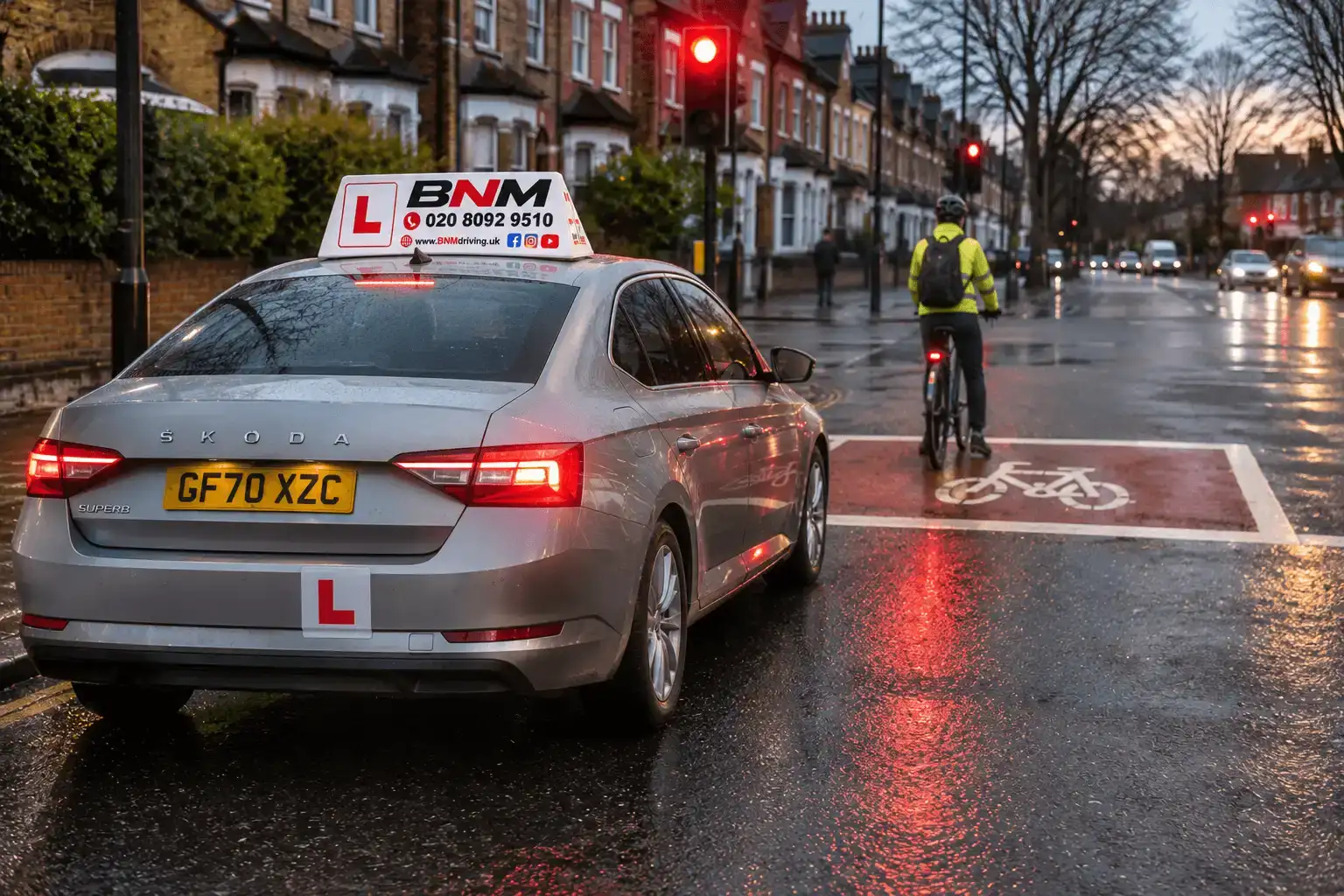
On test: trying to go on a red light. Stopping past the first white line of an advanced stop line for cyclists. Waiting in the junction after the lights have changed. DVSA also marks the opposite mistake: not going on a clear green light or a green filter arrow.
Why it happens: learners decide too late whether to stop. A light that changes as the car arrives leaves no time to think, and the result is a run-through or a harsh stop.
Drill: on every approach to lights, ask “if it changes now, can I stop?” Answer before the stop line, not at it. Then check the exit is clear before going on green, so you never stop inside the junction.
7. Signs: road markings
On test: turning right from a left-only lane, or straddling 2 lanes on a marked roundabout. Crossing a solid white line. Entering a box junction before the exit is clear. Ignoring the markings at mini-roundabouts.
Why it happens: lane arrows are read too late, when the car is already in the wrong lane. Learners look at the car ahead instead of the road surface beyond it.
Drill: before every marked junction, name the lane you need and the arrow that tells you so. Do it 3 car lengths earlier each week until you read the arrows before you reach them.
8. Signs: traffic signs
On test: passing the wrong side of a keep left sign, or crossing a stop line without stopping. Driving in a bus lane during its hours. Choosing the wrong lane against clear signs. Reacting late to a change of speed limit.
Why it happens: signs sit at the edge of vision while the learner watches the road ahead. Bus lane times and speed limit changes are small and easy to miss in traffic.
Drill: after every junction, say the speed limit you’re now in. On bus routes, read each bus lane’s time plate aloud. London bus lanes have hours, and the plate decides whether you can use the lane.
Speed fails: keeping up progress
Speed fails sit at number 10, and in 2025-26 the fault was not keeping up progress. DVSA marks progress for “appropriate speed” and for “undue hesitation”, which it defines as hesitating and slowing down when you did not need to.
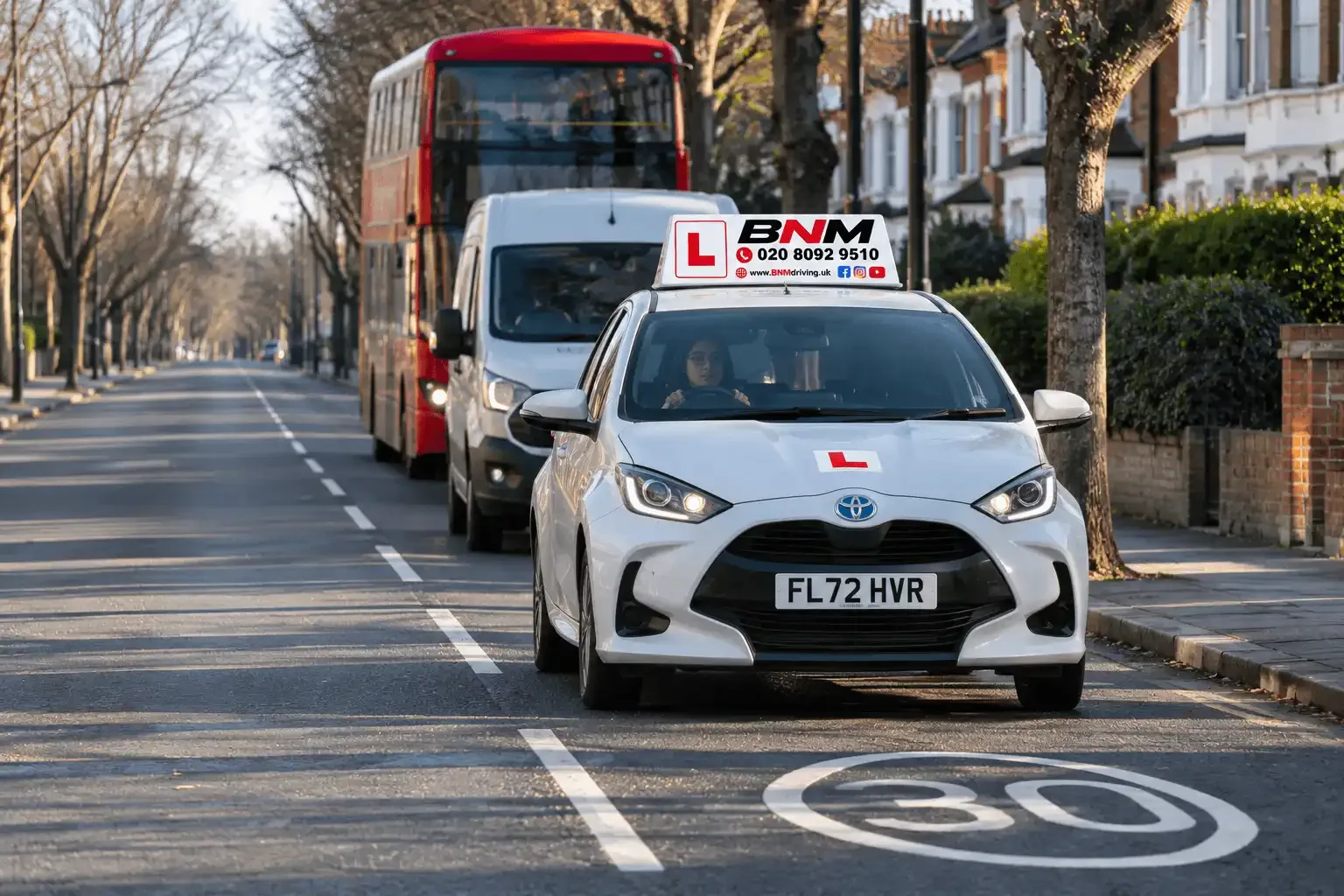
On test: driving well under the limit on a clear road. Waiting at a junction when a safe gap was there. Joining a fast road at a crawl. In 2024-25 the 10th place was the opposite fault, use of speed: driving too fast for the conditions.
Why it happens: nervous learners treat slow as safe. Examiners don’t. A car going 20 mph on a clear 30 mph road makes the traffic behind bunch up and overtake.
Drill: on a clear road, reach the limit and hold it for 1 minute. At junctions your instructor calls the gaps you could have taken, until you take 9 out of 10 yourself.
What 19 years of DVSA data show
19 years of DVSA data show the same 6 faults in every top 10 since 2007-08. Other faults have come and gone. The table below counts how many of the 19 yearly lists each fault appears in, with its 2025-26 rank:
| Fault | Lists (of 19) | 2025-26 rank |
|---|---|---|
| Junctions: observation | 19 | 1 |
| Mirrors: changing direction | 19 | 2 |
| Junctions: turning right | 19 | 3 |
| Control: steering | 19 | 5 |
| Moving off: safely | 19 | 6 |
| Positioning: normal driving | 19 | 9 |
| Signs: traffic lights | 18 | 4 |
| Reverse park: control | 14 | Out since 2023-24 |
| Moving off: control | 14 | Out since 2021-22 |
Source: DVSA table DRT121F, all 19 yearly top 10 lists from April 2007 to March 2026, published 25 June 2026. Road markings appear in 13 lists and traffic signs in 8.
The faults that left the list are car-control faults. Moving off under control, which covers stalls and roll-backs, was last in the top 10 in 2020-21. Reverse parking under control was last there in 2022-23. Reversing round a corner reached number 2 in 2007-08, dropped out of the list after 2010-11, and left the test entirely on 4 December 2017.
The faults that stayed are judgement faults: looking, deciding and placing the car. That matches the result sheet, where a car under perfect control can still fail at a junction. For how each of these is marked as a driving, serious or dangerous fault, read our guide to driving test faults explained. The full yearly lists are in the DVSA’s driving test failure reasons data.
Fails that happen before you drive
2 problems end a test before you drive, and neither appears in the top 10 because no driving is marked. They are listed below:
- Failing the eyesight check: you must read a number plate from 20 metres. If you can’t, GOV.UK says you fail and “the test will not continue”, and DVLA revokes your licence.
- Bringing a car that breaks the rules: the car needs an extra interior mirror for the examiner, L plates front and rear, and no warning lights. If it fails these rules, GOV.UK says the test is cancelled “and you’ll have to pay again”.
Neither one is a driving fault, but you lose the test fee either way. Test your eyesight at 20 metres a week before, and use your instructor’s dual-control car if you can.
Why learners make these faults
Learners make these faults for 4 main reasons, and each one shows up in more than one group. Our instructors see the same 4 behind most test fails:
- Looking without deciding: the head turns, but no judgement follows. This drives junction, mirror and moving-off fails.
- Narrow focus under nerves: a nervous driver watches the car ahead and misses the signs, markings and mirrors around it.
- Too few road types: a learner who only drives familiar streets meets a first box junction or 2-lane roundabout on the test.
- Slow as a safety habit: holding back to stay safe turns into hesitation, which is now a top 10 fault in its own right.
None of the 4 is about car control. In our experience, a learner who passes 3 lessons in a row without a serious fault has usually fixed the reason, not just the symptom.
Training out the top fails
Training out the top fails starts with finding your weakest group. Tick each habit your instructor still points out, and the check shows which of the 4 groups to train first:
Which fail group should you train first?
Tick every habit your instructor has pointed out in your last 3 lessons.
Tick the habits your instructor still points out, and the group to work on first appears here.
Each group is tested on real roads near BNM’s 3 test centres. Near Mitcham, Beddington Lane crosses the tram line at road level. Near Morden, Rose Hill roundabout joins 3 roads: the A217, A297 and B278. Near Tolworth, the A3 runs through Tolworth Junction, where joining traffic needs full progress. Our guide to test centres in South London compares the routes, pass rates and waits.
A mock test brings your group out under test conditions, 2 to 3 weeks before the real one. That leaves time for 2 or 3 lessons on the group it shows.
Frequently asked questions
What is the number 1 reason people fail their driving test?
Poor observation at junctions is the number 1 reason people fail. It has topped every DVSA top 10 since 2007-08, which is 19 lists in a row. Pulling out without judging the speed of approaching traffic is the most common version.
Do most people fail on manoeuvres?
No. No manoeuvre fault made the 2025-26 top 10. Reverse parking under control was last in the list in 2022-23. Most fails now come from junctions, mirrors and positioning on the road.
Can you fail for driving too slowly?
Yes. Not keeping up progress was the 10th most common fault in 2025-26. Driving well under the limit on a clear road, or waiting when a safe gap was there, is marked under progress.
Is stalling an automatic fail?
No. A stall on its own is normally marked as a driving fault. It becomes a serious fault when the stall or your recovery puts someone at risk. Moving off under control, which covers stalls when pulling away, left the top 10 after 2020-21.
Do automatic learners fail for the same reasons?
Mostly, yes. DVSA does not publish a separate automatic list. Automatic cars remove stalling, but all of the 2025-26 top 10 are about looking, positioning, signs and speed, which apply to both.
Are the top fails different at Mitcham, Morden and Tolworth?
DVSA does not say. It publishes the top 10 for Great Britain only, not for each test centre. The roads differ, so practise the junctions, lights and roundabouts on your own centre’s routes.
Can you fail before the driving part starts?
Yes. If you can’t read a number plate from 20 metres in the eyesight check, you fail and the test does not continue. A car that breaks the test rules gets the test cancelled instead.
From the most common driving test fails to an intensive driving course
BNM Driving School is a local, independent driving school based in Hackbridge (SM6). Our DVSA-approved instructors teach manual and automatic lessons across South and South West London, and prepare learners for tests at Mitcham, Morden and Tolworth. Our learners have a 98% pass rate, and more than 2,000 have passed with us.
The most common reasons for failing, from junction observation to progress, are habits, and habits change fastest with daily practice. Learners with a test date coming up take our intensive driving course. It packs 30 hours into 1 to 2 weeks and includes a mock test on your centre’s roads.